Reading with Your Kindergarten Child: Literacy Awareness – A Book is More than a Story

IMG_0238Summer Travel and Reading

We’ve both been travelling with our own families this summer to places near and far, and the topic of “what to pack” inevitably comes up as leaving day approaches. Besides clothes, shoes and a small collection of handbags, there’s going to be few other things to consider depending upon your family’s composition.

For families with very young children, you will probably need to bring the travel baby stroller, car seat and travel cot. We watched in awe as a young family consisting of mom, dad, infant twins, twin 3 year- olds, two baby bucket seats and a double stroller, sat opposite us on our flight. So very brave.

For families with school-aged children, stuffed animals and a few favourite toys are necessary items for travel and as a reminder of home.

For those of us with teenagers, you might think it’s just a big collection of personal devices.

guidesWell… although my family did bring their iPhones and iPads on our most recent holiday (I can’t tell you how many we brought of each because it’s embarrassing and possibly contradicts what we’re writing about), we have a surprising amount of reading material. Between the four of us we have eight books, a Kobo reader and the Globe and Mail from the morning we left Vancouver. Plus, we’re receiving and reading the daily local paper and reading numerous guidebooks and brochures we picked up along the way.

From our gorgeous holiday location, one might wonder, “Why are you reading when you could be outside doing other things?”

Although we are thoroughly enjoying daily all of the outdoor pursuits our holiday has to offer –swimming, boogie boarding, paddle boarding, snorkelling, walking, hiking, zip-lining–we still think it’s pretty awesome that our teenagers love to read and chose to pack books to bring with them.

The kids read on the plane, at night before they go to bed, and yes, we’re all catching up on a bit of American Netflix at the hottest part of the day, but we’re also reading a lot. When I look around during a quiet moment here in our condo, and see that everybody is reading as a personal choice activity, I’m happy and satisfied with the decisions we made when our kids were young.

We’ve been readers our whole lives and sharing the love of reading as a pleasurable pursuit, and fostering and modelling a love of reading at home with our children, has always been one of our highest priorities.


thekinderteam's avatarThe Self-Regulated Teacher

photo-10Do you love reading as a pleasurable, down-time activity?

Do you have a list of books to read that will take at least two lifetimes to complete?

The importance of regular modelling of reading by all us, parents and teachers, cannot be taken too lightly.  The children are looking to us to see if we place a high value on reading through our words and actions.

Last week we wrote about creating a home environment that places reading as a priority to foster a love of reading and literature in our children.

As teachers, our students see us reading a lot.  From the attendance form to story time books, teaching books to charts and labels, our students see us doing a great deal of purposeful reading in our day.

Here are some things we think about as we are reading to and with our students that you can do during…

View original post 762 more words

The Self-Regulated Teacher’s Top 5 Posts for Term 3

I’m attending the 2nd Annual SRL “Inquiry Hub Summer Institute:  Developing Self-Regulating Learners” at UBC from July 2-4, so follow us on Twitter (@selfregteacher) to hear what’s happening!  It’s going to be an amazing opportunity to meet other like-minded teachers who are interesting in learning about, and teaching, self-regulation skills to their students.

IMG_1418Bouquets

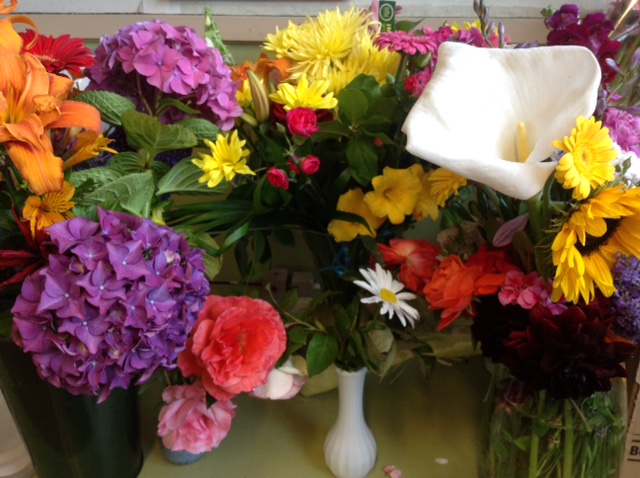
We have bouquets of thanks to give to those who have supported and encouraged us along our Self-Regulated journey.

Our dear friend and colleague, Cari Wilson (@kayakcari) West Vancouver District Innovation Support Leader.  Cari, thank you for your generous friendship.  You gently pushed us out of our comfort zone, and held our hand along the way.  Of everybody you supported this year through your Tech Job, we were probably your toughest gig:  you taught us the “two finger scroll” on a laptop (who knew?); and you didn’t seem to mind the 83 texts conversations!  Although you’ve now passed the “tech torch” on to Christy, we’re still learning and thanks for being there for us.

Our wonderful Ridgeview Principal, Mentor and Friend, Valerie Brady (@valeriejbrady) for your inspiration, guidance and continued encouragement.  Thank you for your endless patience every time we showed up at your office door with “just one more idea to run past you,” and for the numerous times we asked you to read and edit our draft posts (typically the day of publication) and you always so graciously helped us out.

Our West Vancouver (No. 45, not No. 44) Superintendent Chris Kennedy (@chrkennedy), for your praise and support in bringing attention to our blog and website.  Thank you for the time you spend reading our writing and tweeting out about us!

My husband, Brad Daudlin, WVSS Secondary Vice-Principal (@jbwdaudlin).  Thank you for continuing to be my sounding board and coaching me on the social media part of our website. You’ve helped me to find clarity in our goals, determine our audience and their needs, and to visualize the “look” of the website.  It’s exciting to still be working on projects with you after all our years together.

Christy’s husband, Andrew Campbell. Thank you, Andrew, for enduring the numerous hour long phone conversations, the 131 text message conversations before 9am on the weekend, and taking the messages for “Rainbow, or Cheese, Goldfish crackers for Sports Day?” We appreciate the “quick pick up” at Michael’s Craft Store for the much needed pompoms, Sparkle Modge Podge, and cardstock. Your behind the scenes work has allowed us to be able to write and work on our blog.  We both thank you so very much!


IMG_1411We can’t believe it, but today is our 50th post!  It’s also The Self-Regulated Teacher’s Top 5 Most Read Posts for Term Three, so don’t forget to add us to your summer reading list if you missed these posts earlier this year.

Math, the Kindergarten Way

Christy and I are advocates of Math Their Way, the child-centred, manipulative based mathematics program for young children.  It’s always been at the core of our math programs, whether we taught Kindergarten or Grade Three.  Math Their Way uses a hand-on approach to teach and develop concrete mathematical concepts first, then makes the learning connections to abstract symbols.  Starting with Free Exploration, we teach the careful use of manipulatives, working in a group and rotating between math centres.  From there, we move on to teaching Patterns and Number.

About Us

It continues to amaze us that so many people have read About Us!  Christy and I are Kindergarten teachers in beautiful West Vancouver, British Columbia.  We’ve taught Kindergarten since 2006, starting as half-time teachers in the half-day program, for five years.  When the Full-Day program was implemented at our school in 2011, we had enough enrolment for two classes so we decided to end our job-share to each take a classroom and teach our own class.  If you’re interested in learning about how we started this blog and website, we’ve added Our Story:  Becoming The Self-Regulated Teacher to the About Us tab.

Why We Need to Say “Yes” to English Language Learning for Kindergarten Students

We were privileged to have Donna Neilson, West Vancouver School District’s English Language Learning Resource Teacher, speak to our parent group in January of this year.  Donna answered some key questions ELL parents have about their children, regarding ELL instruction, additional tutoring and loss of classroom time for pull-out programs.  Donna compares learning English to the visual of an iceberg:  the children learn conversational English in 1-2 years, which is the tip of the iceberg.  But it is the academic English, the base of the iceberg that we cannot see, and which the children need for the later grades to cope with the reading and writing expectations, that takes 3-7 years to learn.

A Day in the Life of Kindergarten

A Day in the Life of Kindergarten is exactly that:  a description of how we run a typical day of Kindergarten in our classes.  Although this was not a blog post, but part of our Kindergarten Handbook on The Self-Regulated Teacher website, we’ve had a lot of interest in this piece of writing.  We wrote this originally for our current classroom parents, and incoming K parents to our school, so they would have a better idea of the routines and activities their children do all day.  If you are a new Kindergarten teacher, you may find it helpful to read our explanation of how we organize a Kindergarten day.

This Week in Our Room, June 22-25, 2015

This is our last classroom newsletter for the 2014-2015 school year.  It’s always bittersweet to say good-bye to our Kindergarten classes as we grow so fond of them, but we also know it’s time for them to move on to Grade One.  We give a run-down of our last week at school, from our Beach Bubbles Year-End Party, to our role in the Grade 7 Promotion Ceremony, to a brief explanation of the fabulous schoolwork our children have brought home to show their parents.

We will be re-posting some of our earlier blog posts this summer while we’re on holiday.  You can follow us on Twitter (@selfregteacher) to find out when they’ve been posted.  But we’ll be back in September, writing about our new classes and more to do with Kindergarten.

Andrea and Christy

The Classroom Newsletter: “This Week in Our Room” and the Importance of Modelling Writing for Our Kindergarten Children

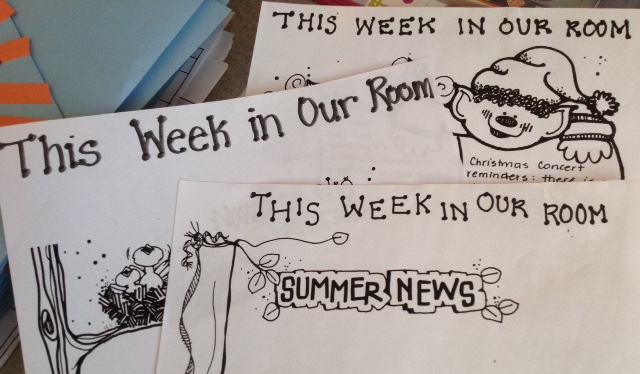
FullSizeRender-3We officially retired our “This Week in Our Room” paper newsletter last week.  We’ve now started an online newsletter that we will write and post on this website on Fridays.  We’ll try to write about one or two topics of interest from the classroom, in addition to the usual wrap-up of the week, upcoming events and reminders.

We’ve been writing a classroom newsletter every Friday, every school year, since we started teaching.  For me, that means since September 1987 (although I missed one year while I was teaching Learning Support).  Christy has been teaching in the classroom (mixed in with Learning Support, as well) since March 1994, so we’ve written many newsletters between us.  It’s been part of our weekly routine, and one that signalled the completion of a week’s worth of work, well done.

We began writing the weekly newsletter as student teachers.  Our supervising teachers sent one out on Fridays, and it was part of our teaching responsibilities to write the newsletter every week during the final practicum.  You certainly feel like you are the classroom teacher when you’re responsible for the main communication line between home and school.

But times are a-changing and there’s a lot of pressure from everywhere to send out newsletters and bulletins electronically to reduce paper and be more environmentally responsible.  It’s a good thing and makes a lot of sense.

In my class, I wrote the weekly newsletter during Friday lunch.  I often sit at a table with the children while they’re eating and they are always amazed to see me filling in the page with print.  They can’t believe I write a newsletter every week (“Didn’t you write that last week?”) and they sometimes think it’s a lot of work.  But I always explain to them the newsletter is for their moms and dads so that they know what’s happening at school.  They love to know what I’m writing, so I always read it aloud to them.

We know that modelling writing is imperative to encourage children to begin writing themselves.  They need to see how much we value this process, similar to reading.  For some light lunch conversation, I would ask my little table group for ideas I might write about in the newsletter; they were delighted to make suggestions, watch me write, and read it back for their approval.  Children really want to know what the words say.

It’s also fun when I’ve already written up an idea they had.  It shows we’re all thinking the same things are important. The children are learning a sense of ownership from participating in the writing process, even just at the idea stage.

Our classes love writing so much because they see us writing all the time.  With the paper newsletter, the children were learning firsthand the newsletter was purposeful communication to be read by a specific audience, their parents.  We were modelling that for them every step of the way, as we wrote it, and handed out the copies for them to take home “for your parents to read.”

They haven’t seen us writing yet on the iPad (we’re currently using Pages for writing all the posts on The Self-Regulated Teacher, but will probably switch to Google Docs soon) since we’ve transitioned to our online newsletter, but that time is coming and we’re sure an interesting conversation will revolve around it.

With the advent of summer, here are a few things you can do to develop and maintain your child’s fine motor skills and interest in writing:

  • Have a supply of pencils, crayons, pencil crayons and felt pens available for your child to write and draw
  • We love to use oil pastels in class which are great for drawing and colouring because they’re so bright (warning: can be challenging to remove if it gets on your clothes)
  • Have some supplies like an individual paint set, glue sticks and child safe scissors ready
  • Recently, our classes enjoy having access to a stapler, tape dispenser, hole punch and string or wool to make “hangers” for their drawings
  • Gather an assortment of little notebooks, or booklets that you can make yourself with scrap paper and a stapler to write in; sheets of paper in all sizes and colours
  • Get your children involved in purposeful reading and writing activities such as grocery lists; to-do lists; writing and sending notes and cards to family and friends; copy a simple recipe for Grandma
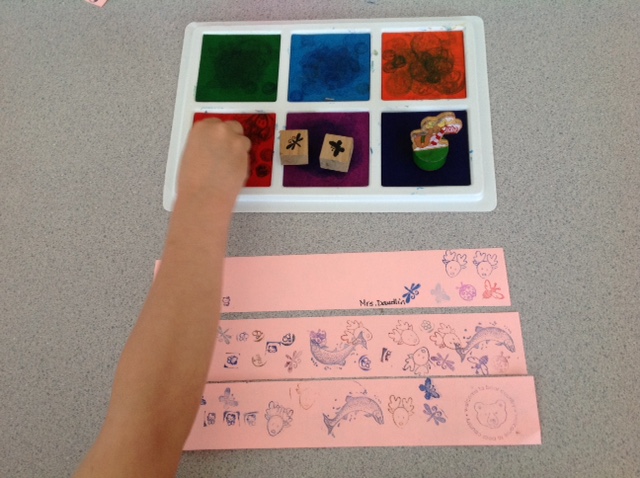
  • Our classes love to use rubber stamps and stamp pads, fantastic for fine motor development

IMG_1189

These activities are going to be the most fun when you sit down with your child, so enjoy this time together and write-on!

Becoming The Self-Regulated Teacher

photo-3Much to our surprise, last Friday we passed a mini-milestone of 30 posts on this blog.

We’ve had a few friends and colleagues make comments or ask questions about The Self-Regulated Teacher such as, “It must be so much work having to think of something to write every week,” and “Where do you find the time?”  Although it’s not hard to think of ideas for writing (every day is a new adventure in the Kindergarten-there is no shortage of something to share) and time is always at a premium (we’re opportunists so we talk and write whenever we can, although we typically edit our work and post on Fridays and Sundays) we thought today we would reflect on how we started this website.

It was this time last year, at the end of April 2014, that we started thinking about how we could better communicate the wealth of information we have about the Kindergarten program to our classroom parents. The week prior we had just hosted our school’s  Welcome to Kindergarten event for all of the incoming Kindergarten students (our current group of children right now) and we were considering plans for the next school year.

We’ve talked about writing a handbook for parents since we started teaching Kindergarten nine years ago.  Although we try to cover as much ground as possible through the Curriculum Overviews and Curriculum Nights each fall, we often found ourselves rushing through our presentations and then feeling we hadn’t quite answered everybody’s questions to their satisfaction.

There is just so much information for first-time parents in the school system, and families new to Ridgeview, and Canada, to learn, digest and assimilate, particularly with the full-day Kindergarten program.  We remember ourselves how completely overwhelming it is when your children start school, and we’re teachers with the inside track!  Sometimes you just want to be able to take a little bit of information at a time, reflect, revisit, reflect again and then you can move on to the next thing.

We’re very fortunate that one of our best friends, Cari Wilson, is not only a Ridgeview Grade 7 teacher, but the West Vancouver District Innovation Support Leader (@kayakcari).  Cari had been encouraging us to switch from our hand-printed weekly classroom newsletter to an online version.  Christy and I were certain that a digital version of the Kindergarten handbook would be our chosen format.  From there the three of us decided we would actually create a Kindergarten website to house the handbook and the newsletters, and Cari would help us to build it and give us technical support until we were ready to manage it independently (sounds a lot like Kindergarten).

But what to call it?

Self-regulation is the cornerstore of our Kindergarten program at Ridgeview.  We have been using The Zones of Regulation  (2011) by Leah Kuypers for the past three years, and influenced by Stuart Shankar and his writing in Calm, Alert, and Learning (2013).  From these resources, we learned that being self-regulated ourselves, and being able to articulate our emotions to model what we were doing to self-regulate our own behaviour in class, would serve as a positive example for our students.  We would be self-regulated teachers; thus, The Self-Regulated Teacher.  It took another eight months of talking, thinking and planning before our first post.

The Self-Regulated Teacher’s primary purpose is as a resource for parents about everything to do with Kindergarten; we are very aware that we write for our intended audience, the Ridgeview Kindergarten parent group, new and seasoned.

Our Kindergarten Handbook holds all the important information about how we do things in Kindergarten at Ridgeview.  It will always be changing as we make new additions to keep it current, depending upon how each school year unfolds.

We started a blog as well to share about what’s happening in our classrooms and at school, as well as writing about the issues and topics important in Kindergarten including self-regulation, early literacy, play and social responsibility.

We inform our Ridgeview parent group that we have new posts on our blog through “Remind,” the app for teachers to remind their students and parents about classroom events and homework.  Our original intention was to have “Remind” replace the classroom newsletter but we found there were not enough characters for each “remind” to write descriptively about our classes, so that is why we write the blog.

As far as the Friday classroom newsletter is concerned, we’re still writing it on paper and will do so until the end of this school year.  We started the newsletter in September, switched to “Remind” in October, and brought it back again when our parent group told us they missed it, and we want to honour their feedback and appreciation.

We are thrilled to be able to share our teaching and classroom experience on The Self-Regulated Teacher as a result of today’s technology.  Through social media and the support of others, we’ve been able to reach farther afield beyond that of our parent group to include teaching colleagues, teacher candidates, administrators and other interested parents.  We are delighted and so appreciative to those of you who have happened to stop by.

Why We Need to Say “Yes” to English Language Learning for Kindergarten Students

photo 4-2We were delighted to welcome Donna Neilson, West Vancouver District’s English Language Learning Resource Teacher to Ridgeview on Friday, January 23, 2015.  Donna spoke to our parents of English Language Learners on the Language Learning guidelines, learning supports in place for West Vancouver students and learning essentials for success through the elementary and high school years.

Donna’s presentation focused on answering some of the commonly asked questions by ELL (English Language Learners) parents.  We would like to share this valuable information with you, plus some of our own thoughts, and how it affects your Kindergarten child.

My child knows everything in Kindergarten.  Why can’t he leave ELL support?

Donna explained that many parents of English language learners say that their children know everything that is taught in Kindergarten, and some do.  These parents may choose to refuse ELL support.

But the thing is, is that while the children do know a great deal about Kindergarten, they do not have the necessary academic English language to succeed in later grades.  If the children leave ELL support, they will not have the background in the English language to help them in the next school year where the language expectations will be much higher.  As the classroom teachers, we know attending ELL classes is necessary.  There is so much more to learning English than just being under the classroom teacher’s direction.

If I send my child to tutoring, will he learn English faster?

No, Donna explained that your child will not acquire the academic English faster with a tutor.  He or she may acquire and perfect some specific skills, but learning language takes time and this cannot be fast paced.

Donna showed us a picture of an iceberg to illustrate this point.

photo

Above the waterline, the part of the iceberg we can see, are Levels 1-2, conversational or survival English, which takes 1-2 years to learn.

Below the waterline, the big base of the iceberg we cannot see, are Levels 2-4, academic English, which takes 3-7 years to learn.

While your Kindergarten child might know many things, he or she only knows the tip of the iceberg.  Your children have not been speaking or listening to English since they were born.  Young English-speaking children have the rich vocabulary, grammar and tenses to which they have been exposed to their whole life.

So imagine how fortunate ELL Kindergarten children are, to be receiving ELL support during their elementary school years, to learn the English language conversation skills, as well as the academic language.  This instruction will be of great benefit to them as they move through the secondary years in the West Vancouver School District (Grades 8-12).  We all need to think long term with regard to English language learning.

What are they missing?  When can my child take regular classes?

Parents often wonder what their child might be missing by going to ELL classes.  It’s a fair question, and one we are frequently asked as Kindergarten teachers.  For the Kindergarten students, we meet with our ELL teachers to discuss with them what our themes or topics of study might be so that the ELL program supports what is happening in the classroom.   Donna reassured us that your children are always taking regular classes, just with ELL support.  And some of that extra support will be given within the  Kindergarten classroom as both the ELL specialist and the classroom teacher collaborate or work together.

Our focus at school is on the success of your child.  We look at Assessment (testing), Placement and Program (how do we support your child?).  Each fall students are assessed and placed in an appropriate program for their level of English.

Our model of ELL support for the Ridgeview Kindergarten is :

  • the classroom teacher and ELL teacher working together so ELL students are receiving in-class support
  • small groups of ELL students receiving direct support in pull-out classes with the ELL teacher

At our school, and across the curriculum, supporting our English Language Learning students is a shared responsibility of all teaching staff.

We would like to thank Donna, and our Principal, Valerie Brady, for their guidance and feedback in the publication of this post.

All About Us!

photo-4

Christy and I (Andrea) are Kindergarten teachers in the West Vancouver School District. We met and became teaching colleagues in February 1994. Four children (a daughter and son for me, two daughters for Christy) and nine years later, we decided to job-share at our current school. We started off teaching half-time (three days one week, two days the next) in Grade One for three years. Then our beloved Kindergarten teachers of 19 years decided to retire and we were asked to move to the Kindergarten.

Christy had previously taught Kindergarten, but not me. She bravely led me through the next five years of Kindergarten, each of us continuing to teach half-time, and in half-day Kindergarten. Those were the days of 40-44 students over the course of a day, and the same number of report cards and parent-teacher interviews!

Fast forward to 2011 and the Full Day Kindergarten Program at Ridgeview was implemented. For Christy and I, it was the “divorce” we never wanted to happen. We had enough enrolment for two Kindergarten classes. We decided to each take one classroom, and have continued to plan and team together to teach our students. We look forward to joining forces again one day, and sharing a classroom.

We’re still teaching Kindergarten and still loving it. For myself, it’s a road I thought I would never take. In my 28 years, and Christy’s 21 years, as teachers in BC’s public education system, we have taught from Kindergarten to Grade Four, including Learning Assistance for both of us. We love each grade for what it is; it’s like loving every age your child is at. However, we’ve found over the years that it’s probably the most satisfying and rewarding of all grades because the growth in each child is so huge. Professionally, we think it’s incredible grounding for even an experienced teacher to see how learning in the school context begins. It’s a tremendous privilege to work with our littlest learners and to set the foundation for learning over a lifetime.