Digital Literacy in Kindergarten

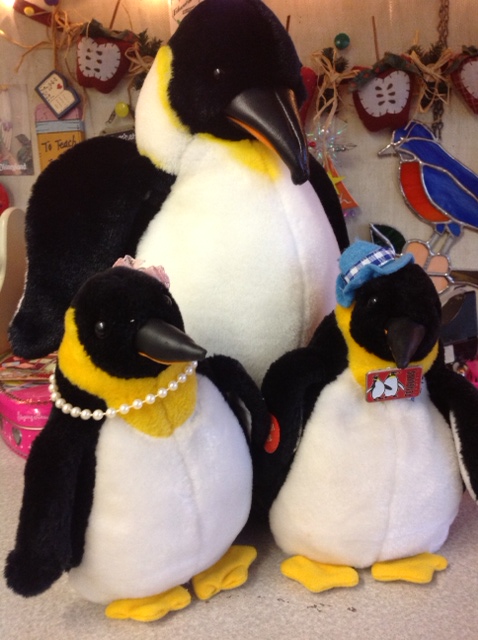
penguinsOver the last number of years, our Kindergarten groups have been the Little Buddy classes to the Grade Seven students.

We love working with our Big Buddies. There is a true bond that develops between each Kindergarten and Grade 7 student(s). There are more Grade 7 students than Kindergarten children per class, so some Kindergarteners have two buddies.

The benefits are mutual for Big and Little Buddies. Kindergarten children have a close connection to senior students who act as positive role models. The Grade Seven students are the lunch and recess monitors, so it’s exciting to have two or three of them in our classroom everyday helping us with our snacks and giving out the Hot Lunch. The older students also help the Kindergarten on the playground to facilitate play, problem-solve conflicts, or take them to the office for a bandaid.

The Big Buddies learn patience and empathy when working with young students. They begin to develop an understanding of the power of influence and setting a good example for our school population.

We see our Buddies about once a week. During our Buddy time together we might work on seasonal crafts, listen to stories, or just play together on the playground. Sometimes there are special events, like the Terry Fox Run, where our Buddies participate with us and teach us how things are done at Ridgeview. Or we may get together to work on a special project, which is exactly what we’re doing right now.

For the past three weeks we have been working on a fun digital literacy project with our Big Buddies. We are learning about page 1penguins as part of our Polar Animals study. Each Grade 7 and Kindergarten Buddy group is creating a digital book on an iPad using the app “Book Creator.” We are researching each of these areas with our Buddies: Penguin Habitat, Penguin Appearance, Penguin Babies, Penguin Diet and the Penguin Life Cycle. We’ll create a “page” for each topic with pictures and write a short, descriptive sentence.
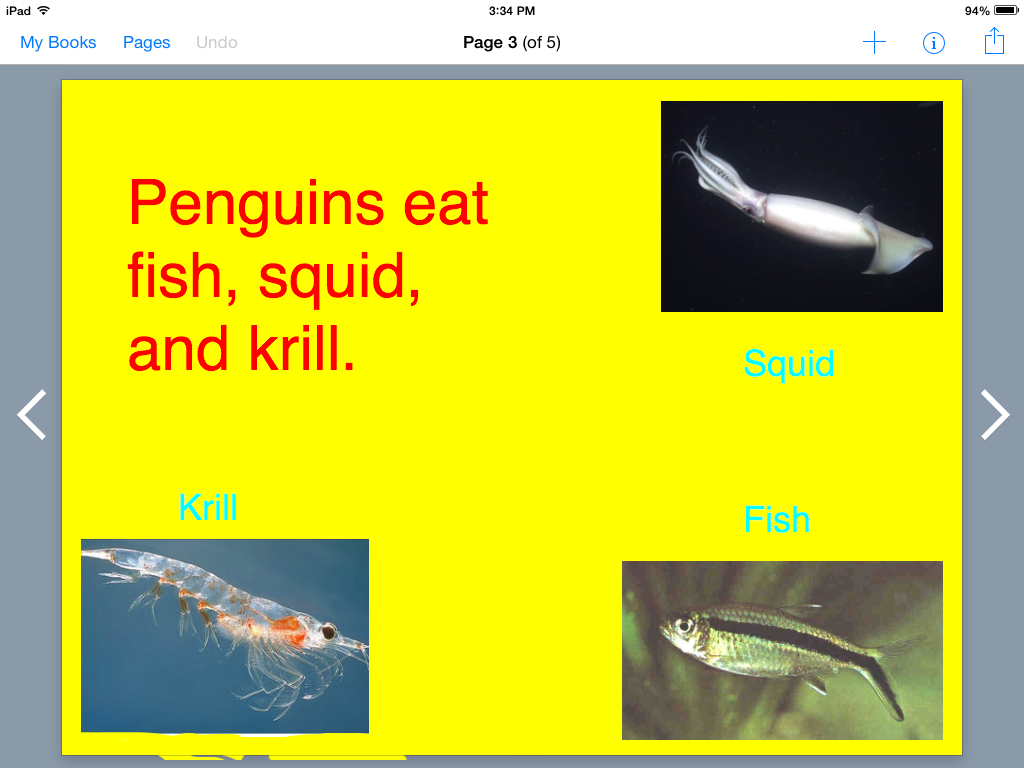
We look forward to sharing our digital projects with you during your child’s Student-Led Conferences on Tuesday, March 3 or Thursday, March 5. This will be the second informal reporting period for our students. There will be more information about Student-Led Conferences to follow on a future post.

In talking with the children about this project, we learned that many of them have access to an iPad, home computer or other device. We’ve also noticed the increasing competence and confidence by which children navigate their way through technology.

We are well aware of the concerns regarding the excessive use of “screen time” for young children. Indeed, our aim is to use technology as a tool in a creative and purposeful manner with our students.

Joshua Becker recently posted 9 Important Strategies for Raising Children in a World of Technology on his blog, becomingminimalist.com. He provides a thoughtful perspective on our role as parents and how we can support our children who are growing up in a technological world far different than our own.
Our Kindergarten Classroom Routines


photo-12It’s been a really busy time in the Kindergarten.  In addition to our regular schedule, Christy and I have been out of our classrooms a couple of times each week for the last few weeks, completing our school district’s Kindergarten/Grade One Literacy Screener with our students, completing the Early Development Instrument (EDI) for participating students and attending Professional Development sessions.

We are looking forward to returning to a regular routine with our students.

Last week we wrote about the importance of getting your child to school on time.

Over the next two posts we’ll explore, as teachers and parents, our thoughts about routines you can establish at home to help your child get organized in the evening so the mornings are not so rushed, an important factor in arriving to school on time. Which brings us back to our greatest comfort, routines.

Let’s start with how we establish routines in the Kindergarten.

Classroom routines are necessary for successful teaching and learning.  From our perspective, classroom routines are one of the pillars of excellent classroom management which, in turn, is the foundation of successful teaching. Classroom management includes clearly established expectations and routines (sometimes called classroom structure); management of desired student behaviour; and organization of lessons in order to maximize student learning, process and productivity.

In Kindergarten the classroom routines are established by us, the teachers.

Partly from experience, and partly through learning about our new class each year, we create routines around student work (eg., Alphabet Books), student activities (Meeting Time, Centres) and any transitions in our class.  A transition would be any time students are moving between activities or subject areas.

Routines give our students security because routines establish boundaries around expected behaviour.  The children know what is expected of them, and the other students.  They feel safe because they know what they are allowed to do, and we teach them to peer-reference (look to others) if they are uncertain.  The children want to please their teachers, they want to do the right thing, and when they feel safe and secure in their classroom environment, they flourish.

Routines give our students predictability.  Being able to predict or know, exactly what is going to happen next, allows the children to relax and be calm and contributes to their self-regulation.  When the children are able to self-regulate their behaviour, all of their attention and positive energy can be focused on listening and learning, following the teachers’ instructions and having fun with their friends.

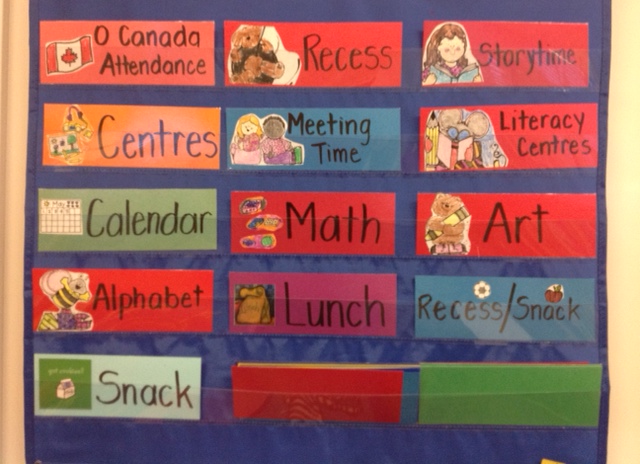
Here is the visual Daily Schedule from our classrooms.  We read it in three columns: the first column is the activities from the start of the day until snack time; the second is from morning recess to the end of the lunch hour; and the third is the afternoon.

photo

The children love the schedule because they know what’s going to happen in class next, when their breaks will be and when we get close to home time.  The children often ask when they can go home during the afternoon as the full day in Kindergarten can be a long one.  When we can show the children on the schedule how many activities there are before home time, they feel they can cope because they can count them down.

Reviewing this visual schedule is part of our morning routine right before Centres.  Sometimes we remember to change it the day before, but lately we’ve started changing it with the children so they can see, and hear from us, how their day will unfold.  The children are developing a sense of the passage of time, which we believe helps them to pace themselves throughout the day.

photo-11

We added the “I forgot…” card to the schedule because inevitably, we will forget something
resulting in a change in the schedule (eg., we forgot the gym is in use during our PE time for a school-wide event or we have to miss Centres to go to an assembly).  Each time we use the “I forgot…” card, it is an opportunity for us to teach our students about being flexible.  We just place the card in front of the activity to be missed or moved to another time or day.

Although there might be disappointment, a five-year old child is old enough to understand that sometimes what we planned for is not going to happen. Kindergarten children are able to learn to be flexible, adjust and accept the circumstances of a given situation.  We try to positively use these experiences in class to teach our students to express their feelings and use a self-regulating strategy to help deal with their emotions.

We begin teaching our classroom routines on the first day of Gradual Entry for Kindergarten.  We start with a routine for how to sit at the carpet during Meeting Time (walk to the carpet; listen with your whole body: sit cross cross on your Alphabet square, hands in your lap, eyes are looking at the teacher, ears are listening to the teacher, mouths are quiet).

We carefully explain what our expectations are, specifically praise the children for showing us the expected behaviour and in the days and weeks to follow, continue to practise and positively reinforce the desired routines and behaviours with more praise.  From there we add our routine for Centre Time (walk to a centre, four to a group, quiet voices, share), and continue building in more routines through the months of September and October.

Our students are becoming independent in the classroom as a result of learning routines.  They are able to do many things for themselves and take a lot of pride from that independence. It’s certainly one of the big goals we want for our children as they grow up and move through the school years.

Literature Based Winter Art

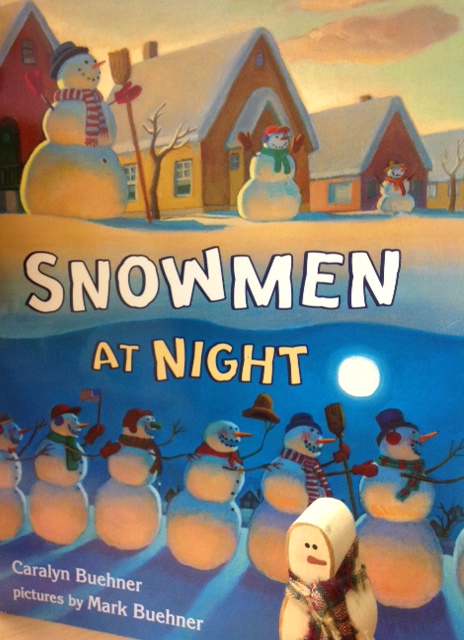
For this week’s book post, we thought we’d share with you some of the beautiful artwork our classes are creating based on two amazing books we read in class on the theme of Winter. You’ll recognize these titles from our post Time to Cosy Up with a Good Winter Book.

nightSnowmen at Night by Caralyn Buehner, illustrated by Mark Buehner.

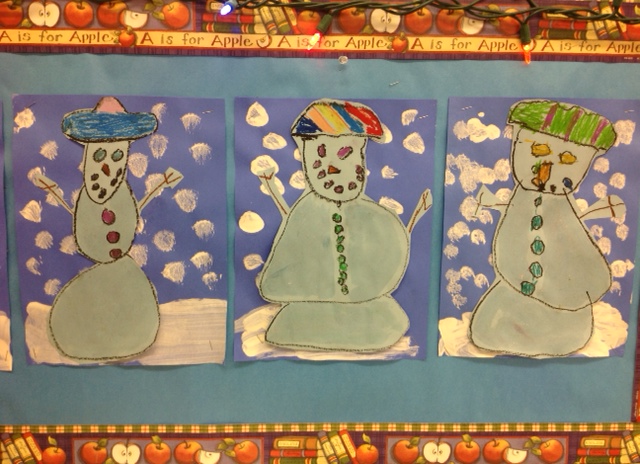
To create these adorable snowmen pictures, we had our first foray into the world of oil pastels. Pastels are a great art tool for our Kindergarten children. Because the pastels are softer than crayons, the children do not need to press as hard but they still get the vibrant colour when drawing and colouring. First, we drew our snowmen and added the details. Then we used Sparkle Mod Podge to give the snowmen a nighttime sparkle effect. For the backgrounds, we painted white “snow” using blue, rather than black, paper for a more luminous look. The children cut out their snowmen before carefully gluing them to the painted backgrounds.


night snow

 This idea is from our favourite Art website, Deep Space Sparkle.


Owl Moon by Jane Yolen, illustrated by John Schoenherr. owlbook


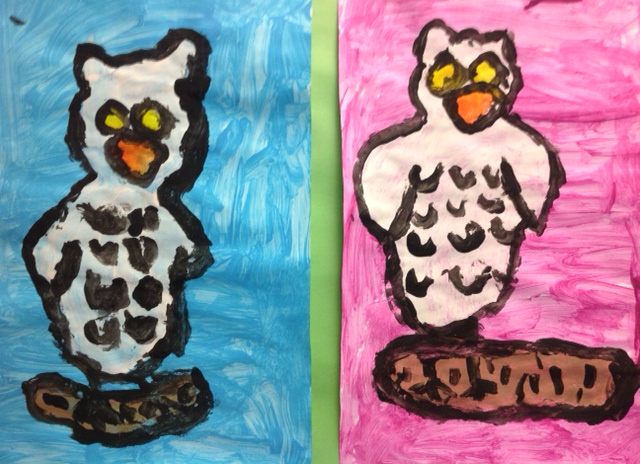
We love big art projects, and this one takes several art classes to complete. It’s important for the children to understand that many great things are completed slowly, over time. By undertaking a multi-step project like this, we can help the children to develop patience and an appreciation of the process involved in creating something special.

The children selected magenta or turquoise to paint their background for the first art session. Then, after the paint had dried, the children followed our step-by-step instructions to paint the owl in white. For our third class, we painted in the details.


owls1

 Again, this art idea is from Deep Space Sparkle.

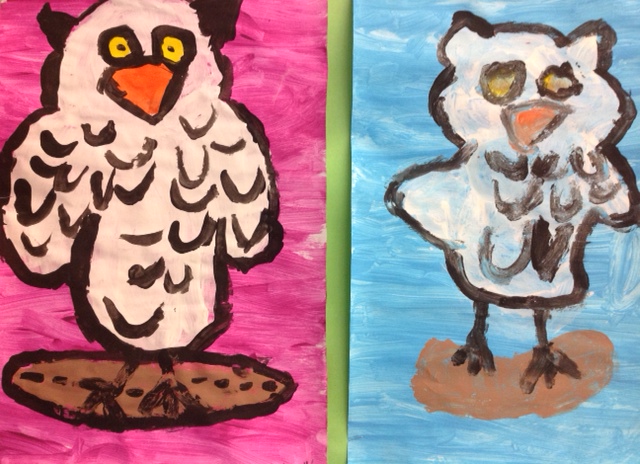
 We have to admit, painting with 21 students on a big scale like this still makes us nervous. But the Kindergarten always takes everything in stride and as usual, they were fabulous in managing their paintbrushes, the multiple paint colours and the oversized paper on small tables. We didn’t spill a drop of paint on the floor and carpets, and our clothing only suffered minimal damage.

owls2

Is there anything cuter than these painted owls? Of course!…… Our Kindergarten children. They are definitely the cutest!

Let’s Get To School On Time!

clock

When we hear the term “parent involvement,” we tend to think about activities such as volunteering in our child’s classroom, helping out with a school fundraiser, or coordinating a PAC committee. All of these roles are important, and certainly much appreciated by the teaching staff, parent group and school administration. After all, our parent volunteers help to make special events such as our classes’ Reindeer Games, or the Hot Lunch program, successful for our students.

But what is the most basic form of parent involvement you can do to support your Kindergarten children?

Arrange to have your child arrive at school on time.

When your children arrive at school on time they have those precious minutes at the start of the day to sort out their belongings, greet their teacher and classmates, and be confident they have not missed out on anything!

Being on time is a life skill, and affects every aspect of living–our jobs, classes and appointments, and even our entertainment such as concerts and sporting events. We all know how important it is to arrive on time for work. Our children’s work is to attend school, and to be on time.

Being on time is respectful to your child’s classroom teacher and the other students. It can be disruptive to the class when your child arrives late as the teacher has already started teaching and the children are involved in their activities. Often the teacher must stop teaching the rest of the class, to get your child settled and brought up to speed. And when your children arrive late, they feel like they are playing catch-up for the rest of the day.

Being on time shows you value punctuality and reliability. As parents, our organizational skills are paramount for modeling to our children that not only must they be on time for school, but we must also show them how to get ready to be on time for school.

There will always be times when your children may be late due to a dentist appointment, you had car troubles or the family stayed out late for a special event. But because we know these things happen, let’s try to be on time for school on all the other days.

If you arrive to school late, after the second bell has rung at 8:55 am, you must report to the school office. You will need to sign the Late Book, and take a “late slip” for your child to give to his or her teacher when entering the classroom.

It is just as important for parents and caregivers to arrive on time for dismissal. Your children have worked very hard during the school day and are excited to tell you all about it at 3 pm. Sometimes, when parents are not at the door to greet their children, the children can become quite upset and worried.

We understand that there are the occasional circumstances that cause a parent to be late for pick up. If you will be late, please phone the school office so that the office can let the teachers know, and then we can inform your child. If you are going to be very late, we will take your children up to the office and you can pick them up from there.

We know that being on time for school requires good planning at home. But what a wonderful gift to give your child, the gift of being punctual, reliable and ready to learn.

In the next few weeks we’ll talk specifically about how we establish classroom routines and how you can establish home routines to help your child be on time for school.

To learn more about Ridgeview’s Kindergarten start time, click here.

To learn more about Ridgeview’s Callback Program, click here.


Library Visit – Week of January 26-30, 2015

photo-9

Two of the “Big Ideas” in the Kindergarten Social Studies Curriculum are understanding our own personal identity to appreciate how others perceive their identities; and that individuals and families need to make choices about their needs and wants based on their limited resources.

During our Library Time this week, Mrs. Kennedy, our Teacher-Librarian explored the concept of family by brainstorming everything the children knew about families.  In looking through their list, it’s clear that the people in their immediate and extended families are uppermost in the Kindergarten mind.  Others sought clarification about cousins, aunts and uncles.  Some of this language was new for many of our Kindergarten students

Then, Mrs. Kennedy began reading aloud from the outstanding book, Families, by photo-8Mary Hoffman and Ros Asquith.  The additions to the children’s understanding of family shows the new vocabulary they learned, and how family members can have more than one role, depending upon one’s perspective.

Our Sharing Theme in class this month has been on Family.  The children have been sharing a family photo with the class and highlighting three activities their families enjoy doing together.  We have created a “Family” photo wall in our classrooms. This ties in nicely with the theme they will now be focussing on during their weekly library visits.

Time to Cosy Up with a Good Winter Book

photo-5We had such an awesome response to our Christmas book list that we thought we would write up another one for you.

We’ve been learning about the seasons and seasonal changes in Kindergarten, and of course we’re focusing on Winter right now. We’ve made some amazing art projects, we’re starting to use frame sentences and next month we start ice-skating as part of our school’s Winter sports program.

But we think the best part of Winter is the chance to cosy up with a good book! We love bringing our classes together at the meeting area and inviting the children to sit closely together to listen to a great story. Here are the books we’ve read recently to our classes.

Winter Book List

Fiction

  • The Hat (Jan Brett)
  • The Mitten (Jan Brett)
  • Snowmen at Night (Caralyn Buehner, illustrated by Mark Buehner)
  • The Mitten Tree (Candace Christiansen, illustrated by Elaine Greenstein)
  • The First Day of Winter (Denise Fleming)
  • Stella Queen of the Snow (Marie-Louise Gay)
  • I See Winter (Charles Ghigna, illustrated by Ag Jatkowska)
  • The Snowy Day (Ezra Jack Keats)
  • The Missing Mitten Mystery (Steven Kellogg)
  • Sadie and the Snowman (Allen Morgan, illustrated by Brenda Clark)
  • Owl Moon (Jane Yolen, illustrated by John Schoenherr)
  • Jolly Snow (Jane Hissey)
  • A Bed for Winter (Karen Wallace)
  • Over and Under the Snow (Kate Messner, illustrated by Christopher Silas Neal)
  • The Biggest, Best Snowman (Margary Cuyler, illustrated by Will Hillenbrand)

Non Fiction

  • Winter Wonderland (Jill Esbaum)
  • Winter (Nuria Roca)
  • Winter (Sian Smith)

Here’s hoping you find time to read some good books yourself!

Popcorn Day and the Marshmallow Test

photo-4Many of you will be now be aware through the media of the “Marshmallow Test”
where a young child is offered a marshmallow to eat. However, if he or she can wait for a certain amount of time (up to 20 minutes), a second marshmallow will be given. It seems our ability to wait and delay instant gratification may be an indicator of faring better in life.

Well, we’ve not administered the “Marshmallow Test” at school, but how about Popcorn Day?

We’ve had two Popcorn Days now since September to support our Grade Seven Year End Activities.

For the first popcorn sale, we collected the children’s money and purchased the popcorn bags ahead of the school sale. Those bags smelled delicious as they sat in a large tray in the classroom while we ate our lunch. The children’s lunch conversation definitely focused on how good the popcorn smelled!

A few children asked if they could have their popcorn with their lunch, but we said to wait until snack time (about 2 pm) in the afternoon. We explained that we wanted them to eat their lunch now, and we didn’t want popcorn dropped all over the classroom floor. We told the children we would enjoy our popcorn so much more if we waited for just a little while longer, and that for a treat we would eat it outside. On their way out to lunch recess, we had a couple more requests for popcorn but we gave the same answer–we would wait until snack time.

At 2 pm we all went outside, sat in the sunshine and thoroughly enjoyed eating our popcorn. Many of the children patiently ate their entire bag; others ate about half and saved the rest to take home. The Kindergarten children had delayed their gratification, for actually quite a long time, and were very accepting of our reasonable explanation.

For the second popcorn sale we did the same thing. We made an advanced purchase and again, the popcorn sat in the classroom during the lunch hour. We reminded the children that we would eat it in the afternoon. We tried to build a little anticipation around the idea of sitting outside on the playground, enjoying the company of our friends and eating our popcorn, and of how much fun that would be. The children left for lunch recess and not one child made a mention of popcorn until we announced it was time to eat!

We would certainly say that waiting, waiting for their turn to talk, waiting to go to a favourite centre, waiting for an activity later in the day, is a skill well practiced by the children.

In Kindergarten, we describe being patient as, “waiting without complaining.” Teaching and practising self-regulation strategies as we do, so the children are a) aware of their emotional state and b) know how to calm themselves or down-regulate, is why they are so calm and patient in class and in this case, able to delay eating their popcorn.

So if Popcorn Day is an indicator of future success, we’d say the Kindergarten group is well on their way.

Now, isn’t it about time for some popcorn? The next Popcorn Sale is Friday, January 30. $1 a bag.

Library Visit – January 19th to 23rd, 2015

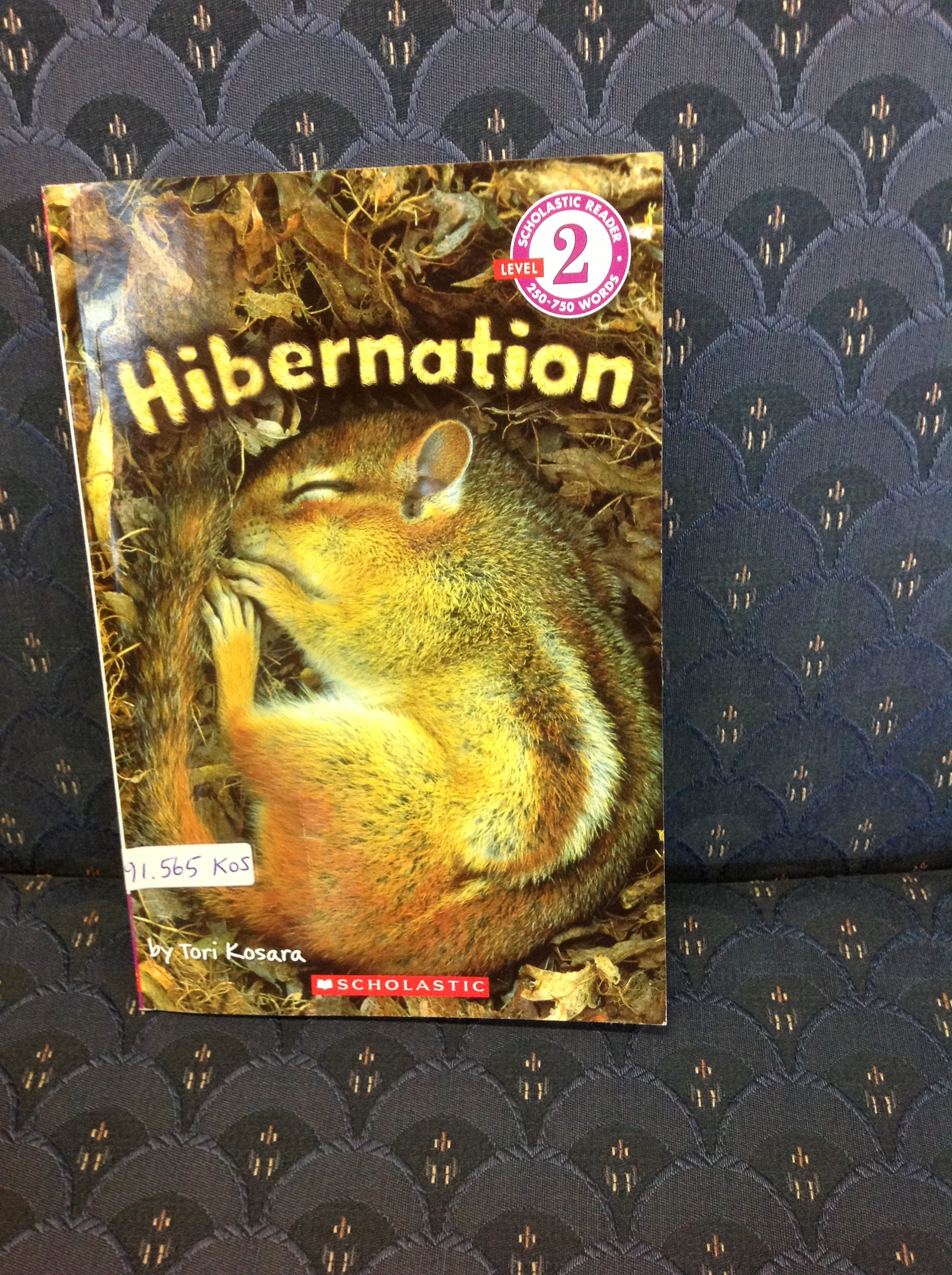
We are continuing our study of Hibernation during Library Time.photo-2

Today the children listened to Hibernation by Tori Kosara.  A new understanding for them is that there are actually two kinds of hibernation.


photo-3Torpor is a type of hibernation where the animals do not sleep all through the winter.  Raccoons and bears are familiar examples as the children knew that these larger animals often wake up and are looking for something to eat.

Hibernation, in its truest sense, is what animals such as chipmunks, hedgehogs and woodchucks do:  they sleep all through the winter.


A wonderful fiction book that incorporates the elements of non-fiction is photo-6Hibernation Station by Michelle Meadows and illustrated by Kurt Cyrus.  We have this set as a listening centre with a CD in our classrooms and it is fabulous.  The background music and sounds are really fun.  This book would make an interesting comparison with the non-fiction books the children have been reading.

Your Kindergarten Child’s Good Health

barbie

We have worked hard at reminding your children to wash their hands after blowing their nose, using the bathroom and before eating, but Kindergarten children are five years old and cannot possibly remember every instruction every time. We appreciate your support in reminding your child about these good habits when at home and school.

With our return to school, and the advent of flu season upon us, we thought it would be a good time to talk about when your Kindergarten child is sick.

Every year we are informed by parents at drop-off time that their child has “a little cough,” “a little fever” or “a bit of a runny nose” but is still well enough to come to school.

When a child is sick, as parents we have a responsibility to not only to care for our child but we also have a responsibility to the classroom and school communities.

A sick child should stay at home, for the mutual benefit of the child, the classroom students and teaching staff. It is good parenting to decide that your child should rest and recover quietly in bed. A child who is given one, two or even three days, to stay at home will get better faster, and be stronger and more able to fight the next cold or illness in the classroom.

We realize as working parents ourselves that it is not always convenient to have your sick child stay at home, as it means taking a day off, or more, from work. However, there are many implications of having a sick child at school.

A sick Kindergarten child often feels fragile, prone to tears and wanting his or her parents. Sending your children to school sick and feeling poorly sets them up for failure, not success.

When the children are sick, they do not have the energy to focus on the lessons of the day. It is very difficult for them to self-regulate their emotions in the classroom context. They lack the patience, because they do not feel well, to cope with challenging schoolwork, possible conflicts with their friends and making good choices.

Sometimes a sick child may still wish to come to school. But in the classroom we are very close to each other in proximity. The children are playing at Centre Time quite close together. They sit close together while eating at the tables. They still hold each others’ hands. Because our supplies are shared, including crayons, scissors, gluesticks and pencils, a sick child at school increases the risk of spreading infection to the rest of the children in the class.

Your child will enjoy their school experiences much more when they return to school rested and healthy!

When%20to%20keep%20our%20sick%20child%20at%20home%202015

Library Visit – January 5th to 9th, 2015

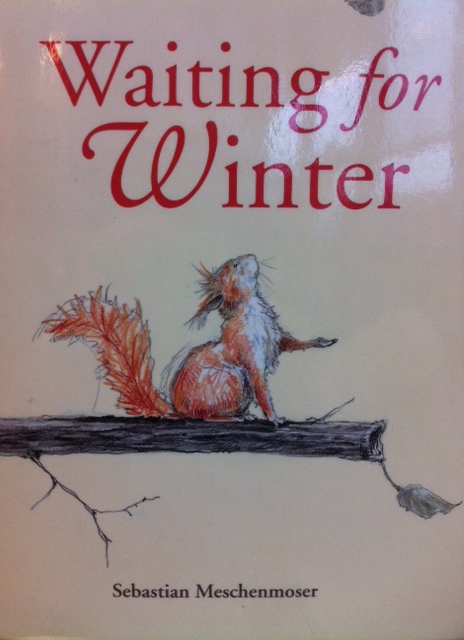
andrea 1This week the children listened to Waiting for Winter by Sebastian Meschenmoser.

As part of their post-discussion, the children brainstormed various animals and the ways in which those animals hibernated.

From their brainstormed ideas, you can see that the children have sorted their facts and identified several animals they still wonder about (those statements are marked with a question mark) that bear further investigation.


Hibernationandrea 2

-bear(s) have a very long sleep

-squirrels go up to their nest and sleep

-iguanas sleep ?

-turtles go to sleep underwater ?

-ladybugs sleep under a log ?

-bees hibernate in their hive

-crocodiles go under the sand to sleep ?

-squirrels store food for the winter

-skunks crawl in to their den ?

-bears eat lots of fish before they go to their tunnel to sleep