Math, the Kindergarten Way

Christy and I were both trained in Math Their Way early on in our teaching careers.  In a nutshell, Math Their Way advocates the use of concrete materials for the children to manipulate to develop and gain a deeper understanding of the Math concepts.  The children are then able to use their knowledge and understanding of the concepts to make meaningful learning connections between the concrete (manipulatives) and the abstract (symbols).  For more information, click on Math Their Way.

Despite the changes over the years in Math curriculum, the advent of new programs and our professional responsibility to remain current of new thinking and strategies, Math Their Way has always formed the core of our Math program in Kindergarten.  We teach a hands-on, child-centred, manipulative based Math program to ensure our students are developing a concrete understanding of Kindergarten Math concepts.  We use a wide variety of manipulatives including pattern blocks, multilinks, threading beads, links, and blocks.

photo 2-3

We start our school year with Free Exploration. This enables us to directly teach careful use of the manipulatives, working cooperatively in small groups and transitioning between the tables as we rotate our way through the Math Centres.  This is an important time for us as we are also establishing important classroom routines which we continue to reinforce for the remainder of the school year.

We assign the children to Math groups and based on our observations of the social interactions, will make adjustments as necessary.  The children play and explore with the Math manipulatives:  they are creating, building, patterning and counting with the many different kinds of materials we have in our classrooms.
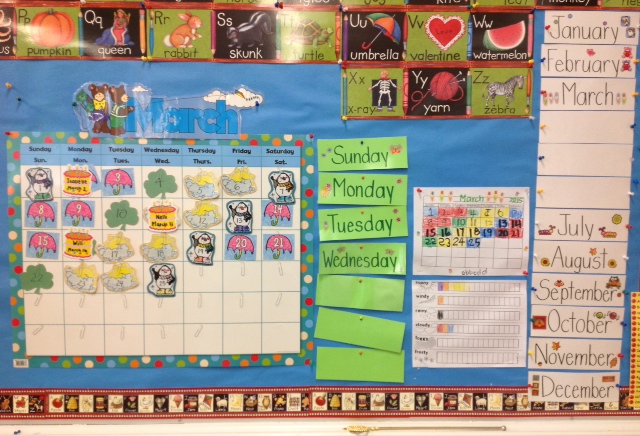
photo 1-2Our next big Math unit is Patterns.  Even when the unit is completed, we still explore and look for patterns all year.  Our Math Their Way calendar is another opportunity for us to create and play with patterns on a daily basis.  We have a special pattern for every month and try to incorporate patterning activities into most things we do.

Now, we’ve just finished exploring number in Math.

According to the Ministry of Education Draft Curriculum for Kindergarten Math Concepts and Content, Kindergarten children must know and understand number concepts to 10 and be able to partition numbers to 10.

Over the years we’ve found that although many of our students can count easily by rote, the concept of number has proven to be more difficult for some of them.

Number includes:

  • Exploring patterns and number with manipulatives
  • Counting (eg., counting manipulatives to a specific number with one to one correspondence)
  • Exploring the processes addition and subtraction, multiplication and division with manipulatives (we don’t name these processes specifically, but refer to making “groups of” or “sets”)
  • Exploring number combinations of a specific number (partition) with manipulatives (eg., 5 = 0+5, 1+4, 2+3, 3+2, 4+1, 5+0)
  • Arrangements of numbers (eg., dice)
  • Connecting the concrete (manipulatives) with the abstract (symbols)
We have created a number combination, or partition, and ascribed a number to the sets.
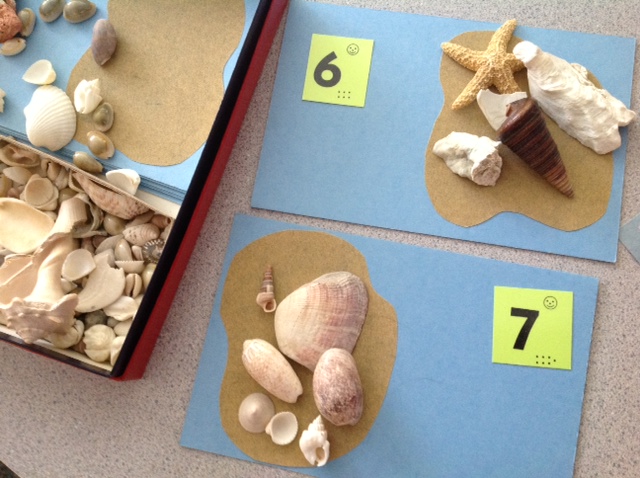
We have created a number combination, or partition, and ascribed a number to the sets.

We have counted sets of numbers

We have counted sets of numbers


In these photos, we’re exploring the number 8.

We made patterns with sets of 8.
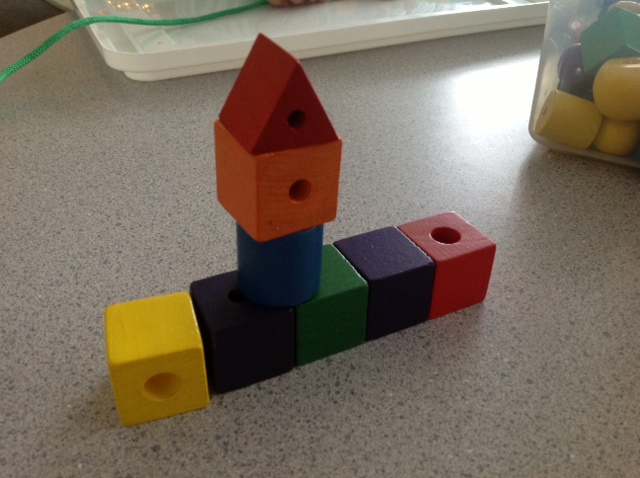
We made patterns with sets of 8.

We asked our students to count out sets of 8.

We asked our students to count out sets of 8.


Connecting the concrete to the abstract.

Representing our learning


We made a connection by creating a picture with wooden blocks and representing our learning by counting and matching the blocks with paper squares.


We hope in teaching Math this way, the Kindergarten way, through exploration, creativity and play, our children will appreciate and embrace the beauty of patterns and logic that make up their mathematical world.

 

Waste Management, Kindergarten Style


We’ve had a pretty big shift recently at our school.  And it’s all to do with garbage.  Yes, we’ve completely changed how we deal with garbage at our school.

Now we call it Waste Management.

When we returned to school this fall, we were aware that change was afoot.  West Vancouver Municipality, like the rest of Metro Vancouver, had declared anything from plants and animals (and biodegradable) to be considered as organic waste and not garbage.  Therefore, organic waste must be separated from the regular garbage collection.

With 21 students in each of our Kindergarten classrooms, eating two to three times a day, and packaged hot lunches four times a week, we create a fair amount of waste.

As experienced teachers, we know that how we start off in September is going to affect us, and our students, for the remainder of the school year.  So although these changes were not going to become official until January 2015, we did not want to start routines, especially ones for an idea as big as waste management, and have to change them mid-year.  There’s been some gentle tweaking here and there, but for the most part the the routines and systems we’ve establish since the fall have been our modus operandi.  For more on the importance of Kindergarten classroom routines, click here.

It is an expectation that our entire student body at Ridgeview, from Kindergarten to Grade 7, learn to separate organics, dry paper recyclables, and garbage/waste items at school this year.

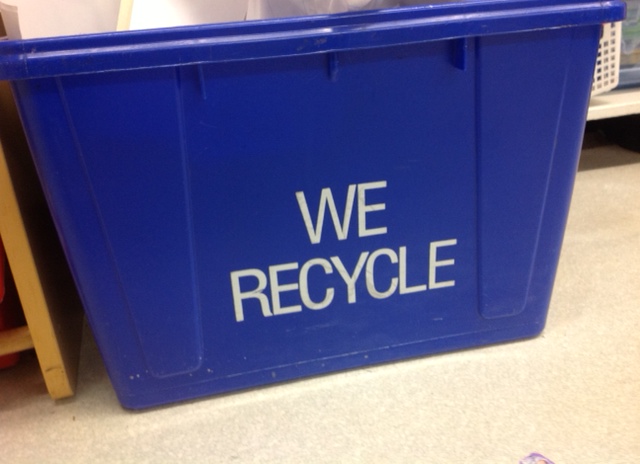
Under our Principal’s leadership, our school has implemented three main systems in our classrooms:  an Organic Waste can, the blue Recycling Bin and a Pack In/Pack Out Initiative for recess and lunch.

In our classroom there are two sorting bins:

Organic Waste Canphoto 1-2

In the Organic Waste can, only four items can be thrown in:

  • Paper towels
  • Wet paper
  • Pencil shavings
  • Tissue


We don’t have a monitor for our Organics Garbage Can, as our children are typically checking with us first if something can go in.  They are learning this routine well, developing independence and looking to the other students if they are uncertain about what to do.


photo 2-2Blue Recycling Bin for Mixed Paper

We’ve noticed the children are very used to the blue recycling bin.  So much so that they are often asking if they can put plastic containers in it like they must do at home.  Unfortunately, we cannot do that at school.  It’s only for dry paper, paper scraps, and charts we’ve finished using in class.

Recess and Lunch–Pack In/Pack Out Initiative

This has been the most challenging of all the waste management initiatives.

This year, students are learning that they are responsible for all food items that they bring into Ridgeview. 

Essentially, any waste our students create from the food they’ve packed in to school (food packaging, peelings and cores, napkins, leftover food) must be packed out at the end of each school day.  All waste must go home to be sorted.

We need you, the children’s parents, to support your child (and the classroom and school routines) by sending a ziploc, or plastic bag, everyday to school for your child’s pack out.  

Some parents have arranged with their children to simply put the food waste and packaging from the day’s food loose in the lunch kit and so far, that seems to going well.  If you do not send a lunch kit to school with your child, then you must send a ziploc or plastic bag for the food waste.


photo 2-3Other parents send snacks and lunch in reusable containers, thereby eliminating the food packaging, and any uneaten food stays in the container.


photo 1-3


Here’s what your children are doing with the pack out of the food waste and packaging.


We have to say that the Kindergarten children have taken quickly to this system and are very proficient at getting their food and packaging waste into the ziploc.  They have shown considerable improvement at getting the bags “zipped” closed.

Hot Lunch

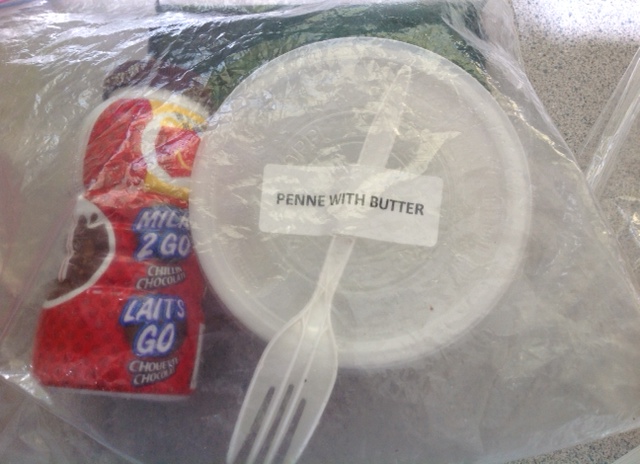
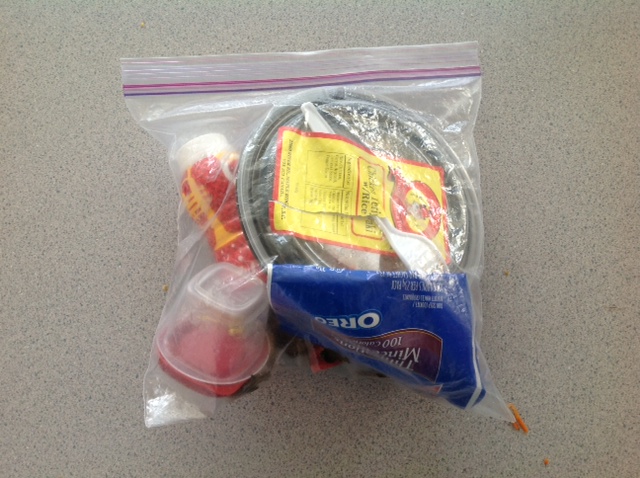
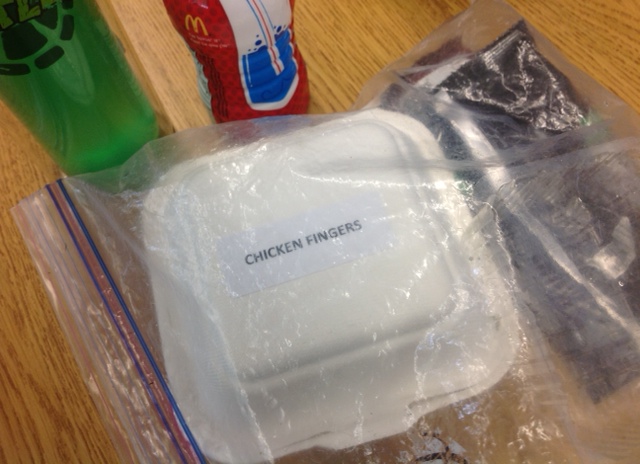
The Hot Lunch days have proven to be trickier.  There is a lot of packaging associated with this program.  Here’s what we’re doing for each day.

photo 1-4


Pasta Day Monday


photo 2-4


Sushi Tuesday


photo 4-2Pizza Thursdays. The Pizza company takes away the boxes to be recycled, and the children can take their leftovers home in their ziploc.


photo 5-1


Wrap and Sandwich Friday


As you can see, sending your child with a large ziploc is better if he or she receives a hot lunch.


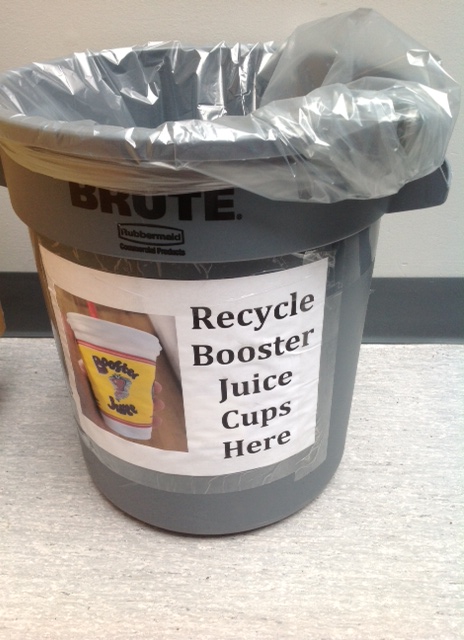
photo 3-3Booster Juice Wednesdays (every second Wednesday).  After the children have finished their drinks, the cups must be rinsed out and the cup, lid and straw are thrown into a special can designated for Booster Juice recycling.  Our Grade 7 monitors help us with this task.


We’re extremely proud of the Kindergarten.  The children know these routines well; they know them as the only way to manage their food waste at school. The Kindergarten is also the only grade in the entire school which does not have to change habits of old.

Change is healthy, but we all know change can be hard as well.  Therefore….we won’t comment specifically on how the teaching staff is coping with food waste and sorting in the staffroom, but let’s just say that old dogs can learn new tricks….

Student-Led Conferences

photo-5There are three formal and two informal reporting periods each school year.   Our Kindergarten students receive their formal written report cards at the end of each term.  Students received their first report card last December, the second report card will be given out on March 6, and the third report will be distributed at the end of June.

This year, the two informal reporting periods are a parent-teacher interview, held last fall, and the Student-Led Conference.

A Student-Led Conference is exactly that–a conference or interview for you and your child, led by your child.  During the Conference, students assume the ownership for reporting and demonstrating to their parents what they are learning about in school.  The teacher, who has supported the students in the selection of student work and practiced the conference with them, stays in the background during the actual Conferences.

During the years we taught from Grades One to Four, our students participated in a teacher-led discussion about the student work they would like to present at the

Student-Led Conference.  A brainstorming session of possibilities would ensue.  There would be suggestions such as a polished piece of writing, the latest math test or a Science notebook; the class would vote on the ideas they liked best and those selections were included in their Student-Led Conference folder.

Depending upon the grade, sometimes we had a combination of “must-have” work and some student choices.  An “art walk” around the school hallways, the latest digital learning project and a mini music performance were other fun choices to round out a Student-Led Conference.

A week or two before the Conference we had our older students write a letter inviting their parents to attend.  The letter would highlight the learning and personal achievements students wanted their parents to particularly notice.  This was a wonderful opportunity for student self-reflection of his or her successes.

For our Kindergarten students we organize our Student-Led Conferences by Centres.  It’s a system the children are familiar with, and one in which we’ve used successfully with this age group.

In the weeks prior to the Student-Led Conference, we review with your children the activities they enjoy most in our day and want to share with you.  We also initiate some discussion on the learning we think you would enjoy seeing as their parents.

We typically include a Language Arts Centre which focuses on the children’s Alphabet and photoWriting Books; a Math Centre to create math patterns and showcase their Math Books; and a Scrapbook Centre to see some of the best work we’ve completed in Kindergarten this year, in the children’s individual scrapbooks.  With the children’s help, we form an “Agenda” of the Centres the children will lead you through.

When you arrive with your child at our classrooms, your child will be given a personal copy of the Agenda and he or she will mark each activity with a sticker as it is finished.  The Centres do not need to be completed in any particular order, but each one must be visited.  We explain to the children that if they see there are many families at one Centre, then they should choose another until it’s less crowded.

During your child’s Conference, parents are able to enjoy looking at their child’s schoolwork and participate in the activities he or she has selected for you.  As parents, giving specific praise and support recognizes your child’s efforts at school.  It is through your comments that you model what you value about your child’s learning.

This is a time for positive comments only to your child.

photo-4At the end of the Student-Led Conference we ask our parents to sign the Guest Book.  It’s important for us to have a record of parent attendance and receive feedback every year.  Over the years parents have always enjoyed the Conferences so it’s very rewarding to have the appreciation of your children’s, and our, efforts.

This year the Kindergarten Student-Led Conferences will be held on Tuesday, March 3 and Thursday, March 5.

All Ridgeview students will be dismissed at 1:50 pm on Tuesday only, and the Conferences will begin at 2 pm.  You will have a 25 minute time slot with your child.  A maximum of four-six Conferences will be held at once so families need to be prepared to speak softly.  At the appointed time, we will ring a bell to signal the end of the Conference so that we may prepare for the next group.

Over the years, a few parents have asked why they cannot have an interview with the teacher instead.

To put it simply, the reason why you’re having a Student-Led Conference is because it’s an incredible opportunity and privilege to share in the learning of your child.

You will hear about your child’s learning from your child’s perspective, and have that deep insight into your child’s thinking, motivations and achievements.  You will be engaged in a dialogue rich with the language of a young learner, share the joy of a job well done, and a sense of pride with every printed letter and cut out shape.  And you’ll be able to share in the delight of your Kindergarten child as he or she begins the journey as a life-long learner.

Student-Led Conferences are one of our favourite days of the entire school year. From a teacher’s perspective, we couldn’t be any more proud of our students as they beam with pride at leading their mom and dad into their classroom to share the fabulous work they’ve completed at this point in the school year.

Please make arrangements for siblings so that your Kindergarten child can have your full attention during his or her Conference.

You can sign-up for your Student Led Conference starting Monday, February 23 at 3 pm.

Start the Kindergarten Day Off Right!


photo 2Last week we talked about how we establish routines  for our Kindergarten class and why they are so important for your child’s sense of security and familiarity at school.

Parents are always so pleased to hear how well their children are managing in Kindergarten.  We attribute that to the classroom routines.  Because the children are so successful with them at school, if you haven’t already set up your routines, here are some you might consider for home.

Preparing for School the Day Before

We’ve learned not only for ourselves, but for our own kids, the importance of starting to prepare for school the afternoon or evening before.  Although this may not seem as relevant right now with a Kindergarten child, as your children move through the grades it will make a huge difference to them (and you).

When your children are leaving for early morning classes, and have a sports team practice or club meeting after school, they will need a lot of things to bring with them on a daily basis.  It’s more than just their lunch:  it’s homework, uniforms, text books…the list could go on and on.

Helping your children while they are young to review their next day’s schedule, and to gather all the belongings they need the night before, is teaching them how to plan and to be prepared.  Together, you are creating a foundation of good habits and organization so that one day your children can be independent and do this for themselves.

For your Kindergarten child, the late afternoon or evening routine might look like this:

Lunch preparation photo 1

  • you, or you and your child, prepare the next day’s snacks and lunch together
  • your Kindergarten child can help to select the snacks, wash the fruit or veggies, butter the bread for a sandwich
  • pack food that does not need to be refrigerated, and any utensils, in the lunch kit
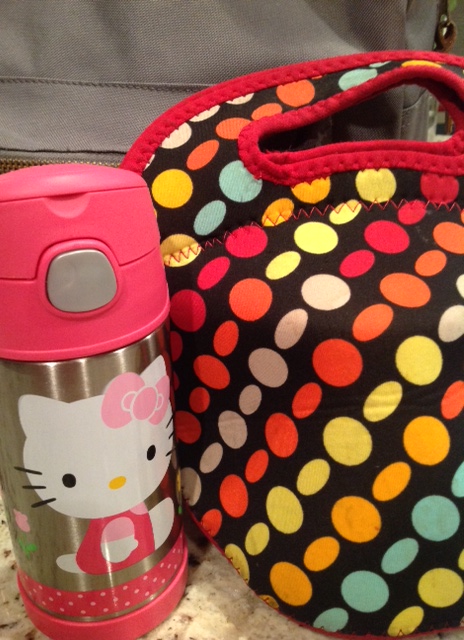
  • water bottle is clean and ready to be filled

Backpack organization

  • library book
  • forms to be returned
  • homework calendar
  • sharing (if it’s your turn)
  • popcorn money
  • extra change of clothes
  • indoor runners if it’s raining
  • ice-skating with your class?  You’ll need you skates, snow pants, gloves and helmet packed in a separate bag, and a pocket snack

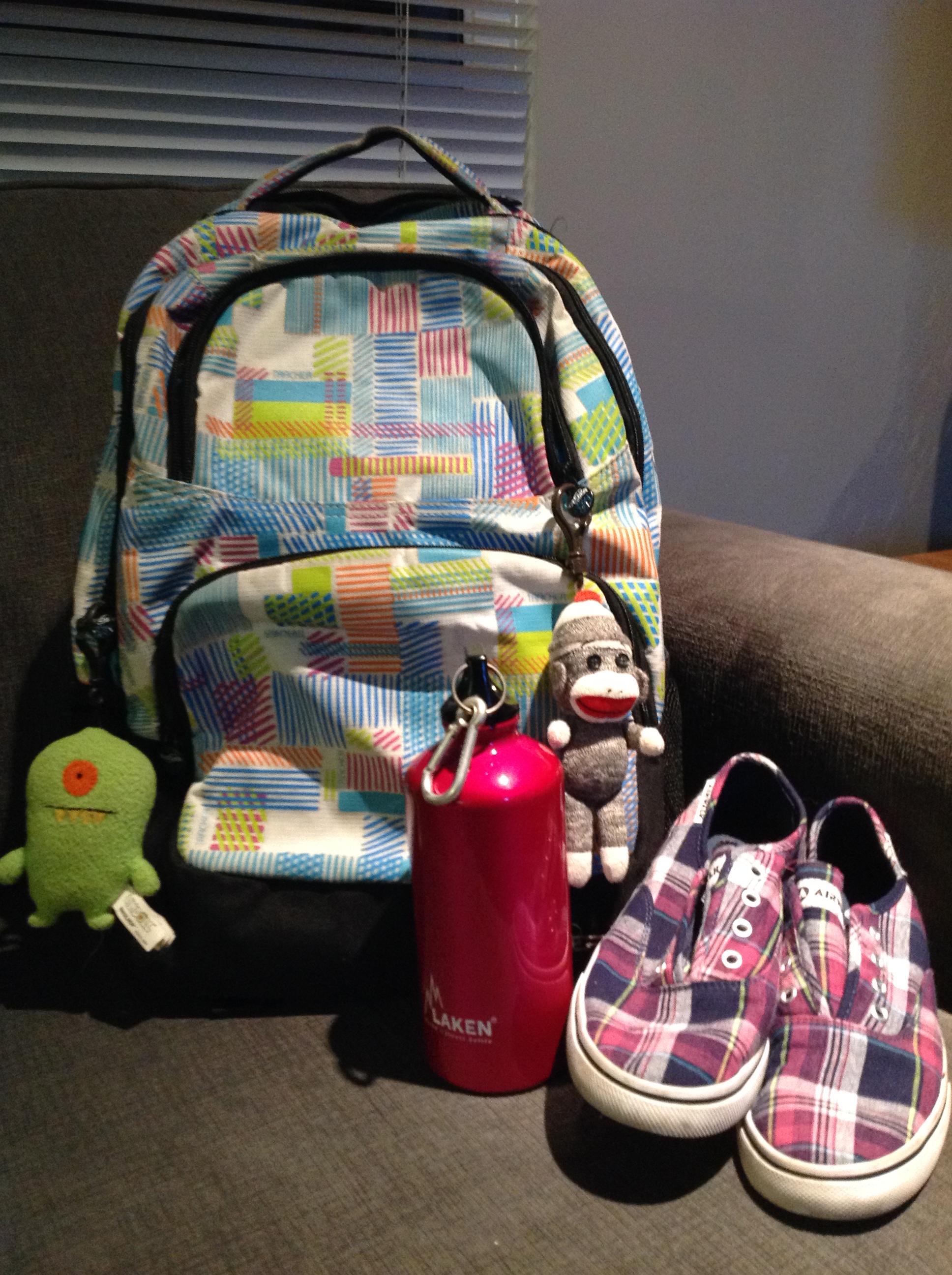
You can show your child how to neatly organize all of the items needed for the next day in his or her backpack; take advantage of the multiple compartments and pack food items separately from papers and books.  Who doesn’t love a well-organized bag to take to work or school?  Then, place the backpack beside the door so all that’s left to do is add your child’s lunch and water bottle in the morning.

Bedtime Routinesphoto 3

Establishing the bedtime routine is important:  the children need to get enough rest each night to stay healthy.   When the children are sleeping they are growing, and when they have enough sleep they awake feeling fresh and ready for school the next day.

As parents, we all want and need our own time to relax.  However, it is a commitment upon us, as parents, to be consistent with the bedtime routine.  Sometimes, we may need to delay our own gratification of the things we wish to do, so that we can be at home and putting our children to bed on time.

For your Kindergarten child, the bedtime routine might look like this:

  • bathe children
  • choose clothes for the next day
  • sometimes another small snack
  • teeth brushing
  • bedtime read aloud (parents reading to the children) and cuddles (lots)
  • time for bed–the children, that is!

Morning Preparations

The morning start, even on a school day, can be a relaxed and easy affair with the right amount of preparation from the prior evening.

There is no doubt you will need to supervise the morning routine.  Let’s face it:  the children are five or six-years old, and we are all distractible in our own way.  Left to their own devices the children could have decided, while still in their pyjamas, to start the greatest Lego castle ever but that doesn’t help with getting to school on time.

For your Kindergarten child, the morning routine may look like this:

  • breakfast
  • change into school clothes
  • brush teeth, wash face and brush hair
  • put lunch kit and water bottle into backpack
  • coat and shoes to head out the door

The last point to consider is this: what do the children do if they are ready early, and waiting to leave home for school?

A transition activity from the time of getting ready to heading out the door might be something to think about.  Each child is different, so activities could range from reading a book to shooting pucks into a net in the basement.  The most important factor would be that the children know that when it’s time to leave, they must stop what they are doing.

The key to creating and establishing routines is time, practice, consistency and persistence.  Every family develops their own routines, and adjusts them as the children grow older.  For the Kindergarten child, and for ourselves as professionals in the workplace, a smooth start in the morning sets the tone for a good day at school.

Our Kindergarten Classroom Routines


photo-12It’s been a really busy time in the Kindergarten.  In addition to our regular schedule, Christy and I have been out of our classrooms a couple of times each week for the last few weeks, completing our school district’s Kindergarten/Grade One Literacy Screener with our students, completing the Early Development Instrument (EDI) for participating students and attending Professional Development sessions.

We are looking forward to returning to a regular routine with our students.

Last week we wrote about the importance of getting your child to school on time.

Over the next two posts we’ll explore, as teachers and parents, our thoughts about routines you can establish at home to help your child get organized in the evening so the mornings are not so rushed, an important factor in arriving to school on time. Which brings us back to our greatest comfort, routines.

Let’s start with how we establish routines in the Kindergarten.

Classroom routines are necessary for successful teaching and learning.  From our perspective, classroom routines are one of the pillars of excellent classroom management which, in turn, is the foundation of successful teaching. Classroom management includes clearly established expectations and routines (sometimes called classroom structure); management of desired student behaviour; and organization of lessons in order to maximize student learning, process and productivity.

In Kindergarten the classroom routines are established by us, the teachers.

Partly from experience, and partly through learning about our new class each year, we create routines around student work (eg., Alphabet Books), student activities (Meeting Time, Centres) and any transitions in our class.  A transition would be any time students are moving between activities or subject areas.

Routines give our students security because routines establish boundaries around expected behaviour.  The children know what is expected of them, and the other students.  They feel safe because they know what they are allowed to do, and we teach them to peer-reference (look to others) if they are uncertain.  The children want to please their teachers, they want to do the right thing, and when they feel safe and secure in their classroom environment, they flourish.

Routines give our students predictability.  Being able to predict or know, exactly what is going to happen next, allows the children to relax and be calm and contributes to their self-regulation.  When the children are able to self-regulate their behaviour, all of their attention and positive energy can be focused on listening and learning, following the teachers’ instructions and having fun with their friends.

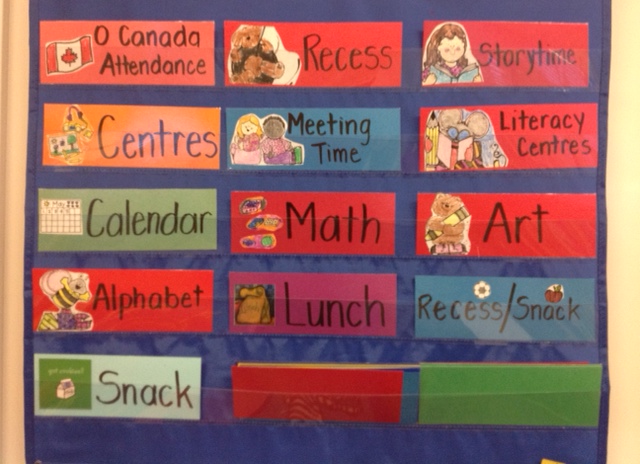
Here is the visual Daily Schedule from our classrooms.  We read it in three columns: the first column is the activities from the start of the day until snack time; the second is from morning recess to the end of the lunch hour; and the third is the afternoon.

photo

The children love the schedule because they know what’s going to happen in class next, when their breaks will be and when we get close to home time.  The children often ask when they can go home during the afternoon as the full day in Kindergarten can be a long one.  When we can show the children on the schedule how many activities there are before home time, they feel they can cope because they can count them down.

Reviewing this visual schedule is part of our morning routine right before Centres.  Sometimes we remember to change it the day before, but lately we’ve started changing it with the children so they can see, and hear from us, how their day will unfold.  The children are developing a sense of the passage of time, which we believe helps them to pace themselves throughout the day.

photo-11

We added the “I forgot…” card to the schedule because inevitably, we will forget something
resulting in a change in the schedule (eg., we forgot the gym is in use during our PE time for a school-wide event or we have to miss Centres to go to an assembly).  Each time we use the “I forgot…” card, it is an opportunity for us to teach our students about being flexible.  We just place the card in front of the activity to be missed or moved to another time or day.

Although there might be disappointment, a five-year old child is old enough to understand that sometimes what we planned for is not going to happen. Kindergarten children are able to learn to be flexible, adjust and accept the circumstances of a given situation.  We try to positively use these experiences in class to teach our students to express their feelings and use a self-regulating strategy to help deal with their emotions.

We begin teaching our classroom routines on the first day of Gradual Entry for Kindergarten.  We start with a routine for how to sit at the carpet during Meeting Time (walk to the carpet; listen with your whole body: sit cross cross on your Alphabet square, hands in your lap, eyes are looking at the teacher, ears are listening to the teacher, mouths are quiet).

We carefully explain what our expectations are, specifically praise the children for showing us the expected behaviour and in the days and weeks to follow, continue to practise and positively reinforce the desired routines and behaviours with more praise.  From there we add our routine for Centre Time (walk to a centre, four to a group, quiet voices, share), and continue building in more routines through the months of September and October.

Our students are becoming independent in the classroom as a result of learning routines.  They are able to do many things for themselves and take a lot of pride from that independence. It’s certainly one of the big goals we want for our children as they grow up and move through the school years.

Let’s Get To School On Time!

clock

When we hear the term “parent involvement,” we tend to think about activities such as volunteering in our child’s classroom, helping out with a school fundraiser, or coordinating a PAC committee. All of these roles are important, and certainly much appreciated by the teaching staff, parent group and school administration. After all, our parent volunteers help to make special events such as our classes’ Reindeer Games, or the Hot Lunch program, successful for our students.

But what is the most basic form of parent involvement you can do to support your Kindergarten children?

Arrange to have your child arrive at school on time.

When your children arrive at school on time they have those precious minutes at the start of the day to sort out their belongings, greet their teacher and classmates, and be confident they have not missed out on anything!

Being on time is a life skill, and affects every aspect of living–our jobs, classes and appointments, and even our entertainment such as concerts and sporting events. We all know how important it is to arrive on time for work. Our children’s work is to attend school, and to be on time.

Being on time is respectful to your child’s classroom teacher and the other students. It can be disruptive to the class when your child arrives late as the teacher has already started teaching and the children are involved in their activities. Often the teacher must stop teaching the rest of the class, to get your child settled and brought up to speed. And when your children arrive late, they feel like they are playing catch-up for the rest of the day.

Being on time shows you value punctuality and reliability. As parents, our organizational skills are paramount for modeling to our children that not only must they be on time for school, but we must also show them how to get ready to be on time for school.

There will always be times when your children may be late due to a dentist appointment, you had car troubles or the family stayed out late for a special event. But because we know these things happen, let’s try to be on time for school on all the other days.

If you arrive to school late, after the second bell has rung at 8:55 am, you must report to the school office. You will need to sign the Late Book, and take a “late slip” for your child to give to his or her teacher when entering the classroom.

It is just as important for parents and caregivers to arrive on time for dismissal. Your children have worked very hard during the school day and are excited to tell you all about it at 3 pm. Sometimes, when parents are not at the door to greet their children, the children can become quite upset and worried.

We understand that there are the occasional circumstances that cause a parent to be late for pick up. If you will be late, please phone the school office so that the office can let the teachers know, and then we can inform your child. If you are going to be very late, we will take your children up to the office and you can pick them up from there.

We know that being on time for school requires good planning at home. But what a wonderful gift to give your child, the gift of being punctual, reliable and ready to learn.

In the next few weeks we’ll talk specifically about how we establish classroom routines and how you can establish home routines to help your child be on time for school.

To learn more about Ridgeview’s Kindergarten start time, click here.

To learn more about Ridgeview’s Callback Program, click here.