
April 20, 2016:  Talk With Your Kids About Money Day


IMG_2758-1“Don’t let money be the tool that trips them up” —Gail Vaz-Oxlade

Talking about money and finances has always been an open discussion at our house but has lately become the topic of urgency, because our oldest child is graduating from Grade 12 and starting University in the fall.  She’s been accepted to UBC and we’re about to enter the world of the Registered Education Savings Plan (RESP) and accessing those funds we’ve been saving for years now.

Today, the third Wednesday of April, has been designated as Talk with Our Kids About Money Day.  Although it seems kind of early (we are Kindergarten teachers, after all) to be talking about money, we know it’s really important to start forming good habits and a healthy perspective about money at a very young age.  Canada’s Task Force on Financial Literacy views that the improvement of financial literacy among young people should be a shared responsibility, a lifelong process and provided for in public schools.  While Christy and I do not concur exactly with that perspective, we do think that some basic knowledge (attributes of coins and financial role-playing are part of the BC Kindergarten math content), financial “theory” (saving some money every month is important and necessary) and the application of money skills (bake sales) can be taught at school.  However, our belief is that the actual teaching of financial literacy is the role and responsibility of parents because money reflects our personal and family values and morals, and is influenced by our cultural heritage.

So we were very fortunate indeed to hear Canadian financial maven, Gail Vaz-Oxlade, speak to parents at the Kay Meek Theatre in West Vancouver last May.  Gail was invited to speak to the students at our three high schools and she also gave a separate parent session.  Although Gail’s presentation was geared for parents of older students, her expertise and savvy in understanding and using money is applicable for all ages.  Gail gave our audience some tough love; she asked sobering questions and made us reflect on our own financial literacy and money habits.  With her usual wit and wisdom, here are some of the highlights from her talk.

“It’s our job as parents to teach financial literacy.”

This was probably the most important idea that we took away with us that evening.  Gail does not believe that financial literacy should be part of the school curriculum:  Teachers cannot give kids the money to create the real-life learning situations.  Rather, it’s the parents who can give their kids the money and take it away.  As parents, we need to learn, know and help our children smooth the rough edges of their money personality, whether it be hoarder, spender, or impulse purchaser.   

Gail emphasised how as parents we need to take every opportunity of our lives to teach our children about money.  Parents often want financial literacy in the school system because they are uncomfortable talking about it. But she reminded us that as the parents, you are your children’s best teachers:  you taught them how to walk, how to use the toilet and how to talk.  You can use each and every day to talk about money related situations.

“Love your children enough to let them learn the lessons properly.”

As our children are learning their lessons about money, our response to them is important.  Sometimes, as a society we want to label children and teenagers these days as being entitled.  But Gail suggests it’s not things, or stuff, that spoils kids.  We spoil them by not having expectations.  We need to clearly state our expectations to our children, what we will, and will not put up with, and allow the natural consequences of poor decision-making to happen, especially those decisions related to money.  As parents, we want to be our kids’ saviours, saving them over and over again.  But, our children have the right to make their own mistakes and to fix them.  Kids only learn to spot mistakes after they have experienced making them.

So, how do you teach kids about money?

Gail recommends that children receive allowances–to put the money you would normally spend on them in their hands.  Then, set expectations about what they will do with it.  We can teach our children how we accumulate money for planned spending for predictable necessities in our lives such as car or house insurance.  What kind of spending do your children need to plan for?

Some of you may be familiar with the “money jars” for spending, saving and sharing that Gail has discussed in her books and on her television show, “Til Debt Do Us Part.” Because money is an abstract concept, putting it into the jars makes it concrete.  For more information about kids, allowances and the “money jars,” click here.

Children must learn to differentiate between “needs” and “wants.”  As parents, we must use this vocabulary correctly and consistently.  Do we always understand ourselves what we mean by needs and wants?  Because language influences how we think about things and the way we spend our money.

“Financial literacy is what you do to move from being dependent to independent.”

We love Gail’s definition of financial literacy.  She said that “being independent is the healthiest you will ever be.”  Why would we then, as parents, not teach our children the financial skills they need so that they can begin the journey to independence?

Gail cautioned us about keeping secrets about money from our children. We need to teach our children about setting goals, planned spending, emergency funds, how interest and credit works, saving for the long term and bank fees, loans and mortgages, none of which should be a secret.  Let’s talk openly with our children–we’re their parents!  Let’s give them the benefit of our life experiences and teach them about financial literacy while they are young, so that one day they can be informed, knowledgeable, independent young adults making their way in the world.

Thank you so very much to Gail Vaz-Oxlade for continuing to inspire us!

We would also like to thank our Ridgeview colleague, Leanne Pruner, for suggesting these resources for you to consider when talking to your kids about money.

Save, spend, share, invest: How to talk with small kids about money

moneycoachescanada.ca

Money Smart Kid$:  Teach Your Children Financial Confidence and Control by Gail Vaz-Oxlade


This Week in Our Room:  April 11-15, 2016

We finished our badminton sessions this week.  What a wonderful time we had, learning about the equipment, throws, and the body language needed when playing with a partner.  Thank you so much to Coach Anna Rice, for making our first formal experience with badminton such a successful one.  Coach Anna left us with some important words of wisdom as we wound up our day:  “In sports, it’s not about being the best; it’s about doing your best.”  We’re excited to think we may have sparked some future Olympians!

The countdown is on, as we finished the letter “X” this week.  We will be working hard to finish up “Y” in our three day week next week, and then “Z” by the end of April.

FullSizeRender-11We’ve got some surprises planned as we started working on our Mother’s Day project!

We will be sending home an information letter and an overview regarding “Let’s Talk About Touching,” our school district’s program for personal safety for Kindergarten in the next week.  We will be teaching this program during class for our students.

We sent home the school supply order form for Grade One on Friday.  Please complete the form and return it to your teacher; or you may choose to order your child’s school supplies online at the website listed on your form.

We’ve also been learning to use an interesting math app for the ipad, DragonBox, with our Grade 7 Buddies.  Rather than using the abstract symbols of numbers, the program aims to develop a child’s number sense with little characters called “Nooms,” which represent quantities and can be manipulated.

Thank you to everyone who donated Tombola bags for our school’s Mayfair, Saturday, May 7.  The organizers are collecting books for the Book Stall, and you can also donate bottles of wine for the Wine Raffle.  It’s going to be a very exciting event with rides, crafts, games and stalls for shopping.  We know your children will love attending an old-fashioned fair!

Upcoming Events and Reminders

We will have a very short school week as we are in session for Monday, Tuesday and Wednesday only.  Thursday, April 21, is a Curriculum Instruction Day and Friday, April 22, is Reading Break.  School is not in session for both of those days.  

Library Book Exchange will be Monday, April 18th for Division 15 and Wednesday, April 20th for Division 16.


West Vancouver Fire and Rescue Meets Ridgeview Kindergarten


We had a very exciting day early on in March when West Vancouver Fire and Rescue (@WestVanFireDept) came to visit us at Ridgeview with a special presentation called “Stories from the Firehall.”

As part of the Kindergarten Social Studies Content, our students are expected to know about “the people, places, and events in the local community, and in local First Peoples Communities,” so meeting with our local firefighters is a tremendous opportunity.  In the Kindergarten we consider the firefighters as one of our community helpers, and we want our children to know and become familiar with the roles and responsibilities they fulfill.

We welcomed Captain Marcia James (Fire Prevention) and Assistant Chief Jeff Bush (@WestVanFireDept) (Fire Prevention/Investigation) to our classrooms to speak to the Kindergarten.

One of the first things we learned is that the Fire Department works in teams, much like we do at school and in our classrooms. Captain James explained that our Principal, Mrs. Brady, is like Chief Randy Heath, Fire Chief of West Vancouver District.  In his role, Chief Heath is in charge of the entire District, like Mrs. Brady is in charge of the entire school.

Assistant Chief Bush’s role is similar to the teachers’ roles in their classrooms, where we are organizing everyone and letting them know what needs to be done in their working teams.

We also found that firefighters are very busy community helpers.  A lot of people think firefighters just put out fires, but actually, they help people in many different emergency situations.  Our firefighters found they were doing a lot of rescues; hence their name, “West Vancouver Fire and Rescue.”

For example, firefighters might go out to help people who are very sick or were in pain.  Or people who are walking and hiking may slip and fall:  if necessary, the firefighters would come out for those emergencies.  The children said they had seen fire trucks where cars had had an accident. But Chief Bush reminded us a fire truck outside a house or building, or at the scene of an accident, doesn’t necessarily mean there is a fire. It might be for some kind of rescue.

Firefighters also come into our schools and inspect them every summer.  They ensure the sprinklers and smoke detectors are working properly and are not obstructed in any way.

Each year our school must have six fire drills so that all of the staff and students know what to do in the event of an emergency.

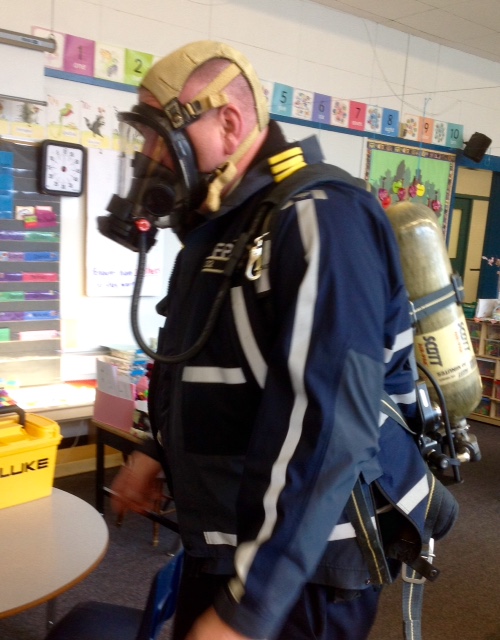
Naturally, the children wanted to know more about what happens when there is a fire.  We learned that the first thing firefighters have to do is make sure it is safe to go into the burning building.  The air can be very bad, so Assistant Chief Bush donned some of the special equipment the firefighters have to wear.  Assistant Chief Bush also spoke to the children through his mask so they could hear what his voice sounded like, and how they didn’t need to be afraid.

FullSizeRender-9

Similar to a scuba diver, our firefighters wear a backpack with an air supply attached to a mask for breathing.  We noticed that Assistant Chief Bush was moving and swaying with his equipment on, and that’s because there is a special detector that senses if the firefighter is not moving; it gives a clue that the firefighter may be hurt and signals will come on to indicate something is wrong.  Communication can be challenging in a major fire and firefighters have to always be able to communicate with each other.

And of course following a fire, another responsibility of firefighters is that they have to go into the building and see how the fire started.

Our children asked some very thoughtful questions and received very straight answers:

  • “What do you do when the bottles (air supply tanks) are emptying?”  A bell rings and you have five minutes before it empties.
  • “How do you open an elevator?”  Firefighters have special keys to open it, or special valves to turn to move the elevator car.
  • “If there is a fire, how does the family get out of the building?”  Children need to ask their parents, “What is the family escape plan?”  Everyone needs to listen to the smoke alarm and make a plan to leave the home and meet in your designated meeting place.
  • Some thought they should hide if there is a fire so it was an opportune time to review what children and adults should and should not do in a fire.

It was good reminder for all of us to think about the family escape plan. When a smoke detection device detects smoke, the alarm is sounded so the inhabitants of the building should get out right away.  The smoke will be hard to see through, so we’re to get down low to the ground and crawl; air is heavier than smoke so the smoke would be above us.  Fires can be noisy and dark so it’s important to yell and shout as we’re making our way out.

As well, smoke detection devices need to be tested and checked.  October has typically been Fire Prevention month, so checking your smoke and carbon monoxide detectors’ batteries around Thanksgiving would be a wonderful way to show thanks and gratitude for our wonderful families.

No firefighter visit is complete without a visit from a fire truck, so you can imagine our children’s delight when this beauty came driving onto the playground!

FullSizeRender-10

The children suspected something was going to happen as we waited for the playground gate to be unlocked:  the fire truck flashed its lights and whistled at us a few times and then the excitement really began!

All of children had a turn to climb up into the truck and sit on one of the seats, and some of them also took the opportunity to wear the firefighters’ headsets.

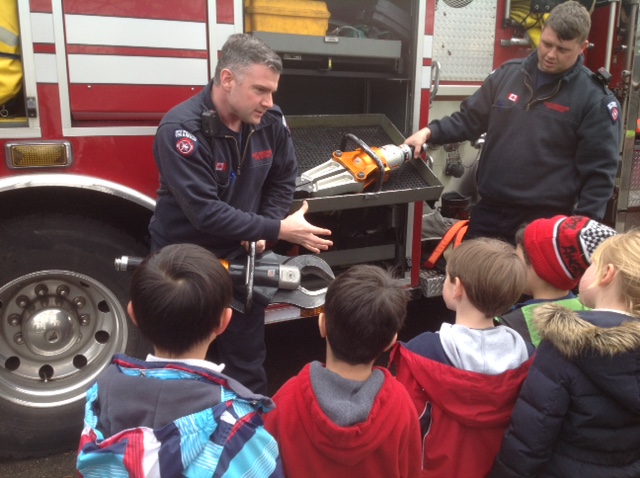
We saw the yellow hoses, checked out the water valves, learned about the jaws of life and tested out the weight of a firefighter’s helmet.  We engaged in a long discussion about the blocks used to stop the fire truck from moving, or rolling backwards, while the firefighters were working. It was a very wonderful visit!

IMG_2628

We were particularly pleased to know that our students now have some familiarity with the firefighters, particularly when dressed in their uniforms.  We wanted the children to see how firefighters look in their jackets, and with the helmet and shield over their faces.  The children need to know not to be afraid or hide from the fire or a firefighter.  The firefighters come to help and rescue them.

We would like to thank Captain Marcia James and Assistant Chief Jeff Bush so very much for visiting and sharing with us the roles and responsibility of one of our most important community helpers, the firefighter!


Forest Play

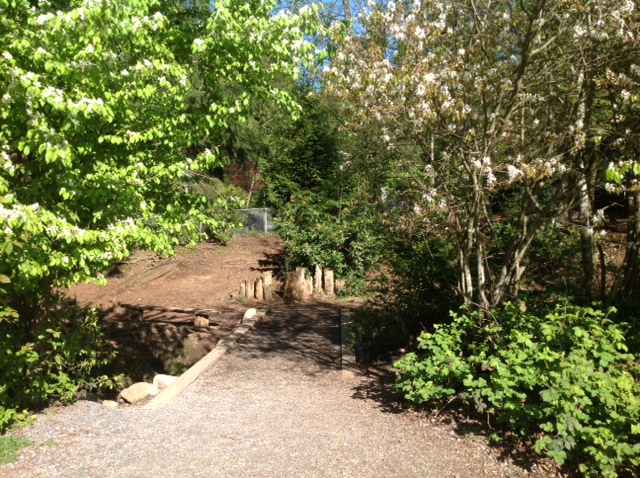
Our school is located in West Vancouver, on an extensive property that has much to offer in the way of natural beauty and physical activity for our children.  We have a large grass field, in addition to a gravel field, a newly paved playground with painted hop scotch, four square and tether ball lines, a huge playground climbing structure and the jewel in our crown… a small forest.

IMG_2735

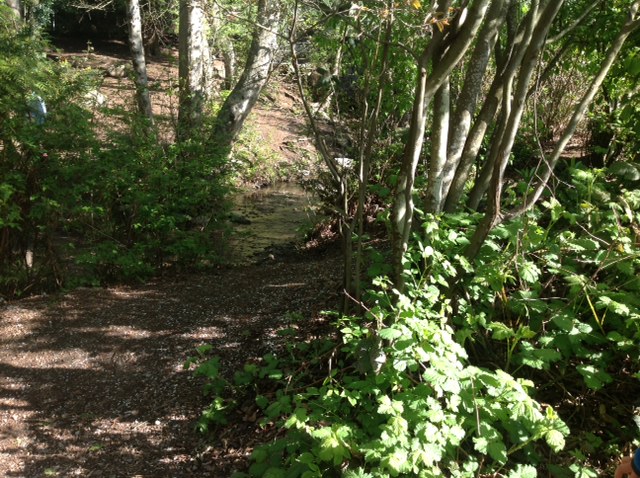
Our forest is a tiny gem, tucked into a corner of our school grounds, sparkling with the dappled sunlight shining through the trees and a glittering creek running through it.  Step across the bridge from the playground into the forest and you’re suddenly engulfed in a world of calm, quiet and clean air…perfect for a self-regulatory moment.

IMG_2737

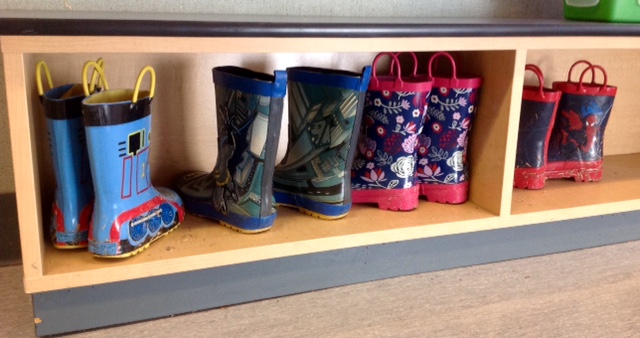
In addition to our regularly scheduled morning and lunch recess, and afternoon play times, we’ve designated Friday afternoons as our Kindergarten Forest Play day.  We have an extended playtime where the children are free to bring their rain boots and explore the area under our direct supervision.  Although tempted to bring out purchased buckets and shovels, we’ve decided to just let nature truly run in its own course and ask the children to use whatever found objects they can find as they create their own imaginative play.  We’ve allowed the children to use sticks in a safe manner for digging, and with the fallen treasures from shrubs and trees, the forest is a place of learning.

Earlier this week, our Vice-Principal, Mr. Blackburn (@njwblackburn) reviewed the expectations with us for safe forest play:

  • the forest is our outdoor classroom and we treat it carefully and with respect
  • Kindergarten students can only go into the forest with their teachers during school time
  • we walk across the bridge; we do not stand on the sides of the bridge as it can dangerous and slippery when wet
  • we are mindful of the tree roots when walking and climbing
  • we walk in the forest so we can notice any living creatures on the ground and not step on them
  • we are respectful of other children in the creek and do not purposefully splash or kick water
  • we respect living things in the creek so sticks and rocks stay on the ground
  • we respect the trees and shrubs by not picking leaves, branches or flowers off of them; it’s ok to pick up things which have fallen to the ground
  • we wear boots for water play to keep our socks and feet dry and comfortable
  • it’s ok to use a stick for digging, but keep it pointed down while walking
  • we respect the boundaries of the fence, the large rocks at the base of the water drain and the walk way above the water drain.  Those areas are all out of bounds.

This Week in Our Room:  April 4-8, 2016

The big excitement in the Kindergarten this week has been our forest play and badminton!  We were super impressed with our classes during their badminton instruction with Coach Anna Rice.  The children were listening with their whole body!  This week we’ve learned how to hold the shuttle properly, the parts of the shuttle, care when moving around the nets and correct stance.  We will be continuing next week so please remember to wear your runners on your PE days.

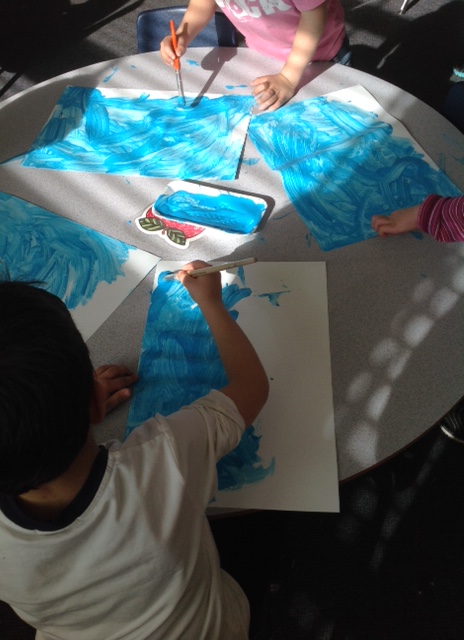
We’re heading into the home stretch for our Alphabet Work.  We finished “w” and painted blue waves for our Alphabet craft.

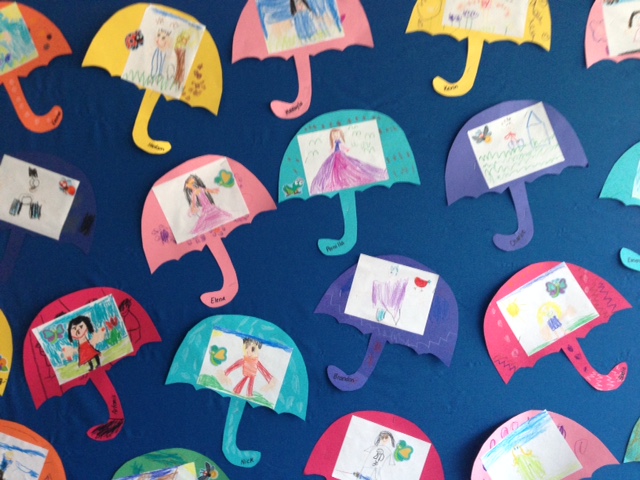
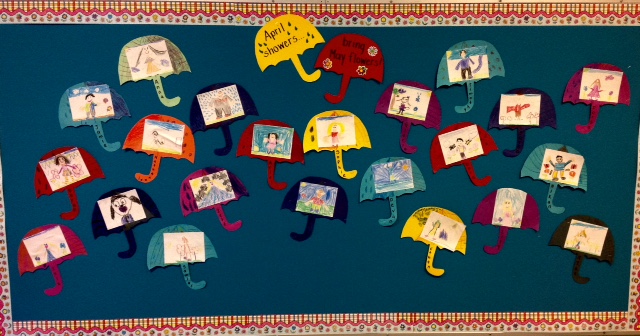
Our April self-portraits theme was “April Showers Bring May Flowers.”

IMG_5202

FullSizeRender-7

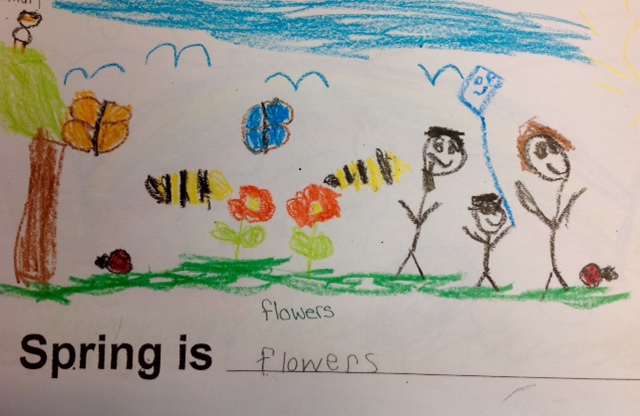
We’ve been reading books about Spring and talking about seasonal changes and how that affects human and animal behaviour.  Today we completed our “Spring Is….” big books.

FullSizeRender-6

IMG_5203

Vancouver Coastal Health nurses came to visit us on Wednesday so vision, hearing and dental screeners are now complete on all Kindergarten students and you should have received your child’s results from your classroom teacher by now.

Upcoming Events and Reminders

We sent home a Remind earlier this week, but we are planning now for Sports Day which will take place on Friday, June 3 and all Kindergarten students take part. We’ve had a request from the school office to find out if any of our children will not be in attendance that day due to leaving early for the school year or family travel.  Please let us know as soon as possible.

We’re still collecting Tombola bags for Mayfair, so if you are able to make a few extra, please let us know and we can supply you with some bags.


Communicating Learning:  Today We Celebrate 101 Posts for The Self-Regulated Teacher!

IMG_0703A special thing happened 15 months ago and that was the creation of our little website and teacher blog, The Self-Regulated Teacher.  We never dreamed that we would have received over 12,000 views (12,398 to be exact at the time of writing) by over 6500 visitors to read what we had originally planned as one form of communicating learning for our Kindergarten classroom parents.

We carried this idea around for a long time, and with the help, support and encouragement of one of our BFFs, Cari Wilson, Innovation Support Teacher (Technology) for West Vancouver and our Ridgeview Principal, Valerie Brady, we published our first post in December 2014.  We’re appreciative of the positive feedback from our classroom parents and others readers of this blog.  Thank you for leaving us your kind comments and questions.

As we reflect on the various ways to communicate learning that we’ve used over the years, beyond the three written report cards, parent-teacher conferences and Student-Led Conferences, our primary method has been the classroom newsletter we’ve written every week since we started teaching, from Kindergarten to Grade 4 (not including the years we were Learning Support teachers).  We originally wrote this by hand until recently when we’ve started to post it online.

Each and every parent group has always enjoyed, “This Week in Our Room,” to review the goings-on of the past week, with reminders for the upcoming week.  We know those newsletters graced many fridges, were placed in special binders or pinned to the family bulletin board.  Families tell us how they kept all those handwritten paper newsletters from the Kindergarten year as a classroom memory.

Our families need to know, and love knowing, what’s happening in their child’s school life.  Supporting the children in their learning, and extending the learning at home, requires that parents have an awareness of the classroom routines, curriculum and activities.  In our situation, we wanted parents to be able to take the information we provide through the newsletter, and use that as a basis for conversation beyond the ubiquitous, “What did you do at school today?”  Our classroom parents are knowledgeable about what their child is doing at school, and can ask the pertinent questions to help uncover the learning gems each child knows.

We realise that our level of communication is going to be different in Kindergarten, compared to a student in the older grades.  Our children are more than able to share with their parents what we do at school, but the rationale for an activity might not be as clear to them or there were too many reminders on a certain day, and we like our parents to know these things.  We consider classroom communication a teaching responsibility, so if reminding our parents to send along a pair of rain boots for outdoor play, or making suggestions for reading at home, contributes to a fun and successful school experience, then we’re going to do it.

We’ve noticed an increase in the number of working parents in our classes over the years and as working parents ourselves, we wanted to improve when and how information can be accessed and technology has allowed us to do so.  Working parents cannot always drop by the classroom to see the latest bulletin board display or see when it’s their child turn to be the next Special Helper.  Our first foray into digital home and school communication started with the app Remind, which delivers text messages from the teacher to the classroom families from an account separate from your smartphone.  It allows us to schedule Remind texts days and weeks ahead, as we think of them, and to include photos as well.  We highly recommend it as an excellent method to send reminders home.

From Remind we made the jump to writing and posting the newsletter online.  It’s actually easier and faster for us now, because Christy and I would meet in person or discuss by phone what we were going to write. We can write our newsletters and blog posts on Google Docs, share it with each other and we can both be reading, revising and editing at the same time (as we’re doing right now), or when it’s convenient for us, before we copy it into WordPress, our blogging platform.

We don’t necessarily endorse that a classroom website and weekly blogging is for everyone.   We were already used to writing the newsletter, and looking for ways to increase our efficiency and reduce paper consumption.  We now write a short blog followed by the newsletter on Fridays.  We work on it over the week, adding bits of information as we think of it.

On Sunday we write a blog post that is current and relevant for what’s happening in our classrooms and at our school.  These blogs take more time because of the topics we choose to write about; however, we love sharing what we’ve learned through our teaching and experience and have achieved a great sense of satisfaction and accomplishment through writing and publishing.  We’re not going to romanticize blogging, though.  Although I love writing and have a passion for writing, writing takes time and periodic bouts of writer’s block can seriously extend the amount of time you were planning to spend on writing one post, never mind how the rest of your evening (or day) was affected.

Our Kindergarten website focuses on school and classroom expectations and routines, and foundation learning for our students.  Again, our original intention was to write a Kindergarten Handbook, a “how-to” for negotiating Kindergarten here at Ridgeview, and we decided to just have everything, our newsletters, blog and handbook information in one place, theselfregulatedteacher.com.  You can read more about “Becoming The Self-Regulated Teacher” here.


Book Nook: The Salmon and the Orca Whale in First Nations Stories

FullSizeRender-5We’ve just finished learning about the salmon and the orca whale in our on-going study of animals in The First Nations culture.  Our Teacher-Librarian, Mrs. Kennedy, has recently read and discussed some beautiful books with our classes during their Library time.  

Common themes such as learning from family members, passing on knowledge and ways, and an appreciation and respect for animals and the natural world form a basis for storytelling as part of the First People’s Principles of Learning, “Learning is embedded in memory, history, and story.”

We’ve decided to collect a variety of titles, from First Nation stories to other well loved favourites, and highlight a few of them for you.  You might wish to consider them as additions to your own home library.

Sharing Our World:  Animals of the Native Northwest Coast is beautifully illustrated and written in clear and simple language.  Each of the animals represented is described by its individual qualities.  For example, “Salmon have always been our most important food source.  We can protect salmon by keeping our rivers and oceans clean.”

Good Morning World (artwork by Paul Windsor, Haisla, Heiltsuk) is a pattern book, focusing on the beauty of our natural world and the positive energy we have from starting a brand new day.  “Good morning salmon swimming up the stream.”

More titles:

  • Waiting for Whales (Sheryl McFarlane, illustrated by Ron Lightburn)
  • Sockeye:  The Adams River (Adam Lewis)
  • Salmon Stream (Carol Reed-Jones, illustrated by Michael S. Maydak)
  • P’esk’a and the First Salmon Ceremony (Scot Ritchie)
  • Dip Netting with Dad (Willie Sellars, illustrated by Kevin Easthope)
  • Orca Chief (Roy Henry Vickers, illustrated by Robert Budd)
  • A Salmon for Salmon (Betty Waterton, illustrated by Ann Blades)

To learn more about the Bear in First Nations Art and Stories, click here.

This Week in Our Room:  March 29-April 1, 2016

Welcome back to school!  How wonderful it has been to teach the children this week, more mature than ever, and watch them quickly settle down to familiar routines like a well-oiled machine.  They were very excited to see each other, play together during Centre Time and at recess and get back into their school groove.

We had a very fun first day back on Tuesday with a school assembly right after the holidays!  We got to see Dreamrider Productions’ presentation of “H2Whoa,” an excellent play about the importance of water conversation, and brought to us by the Municipality of West Vancouver.  Our children watched and learned to be a Planet Protector, just like the heroine, Esmeralda Planet Protector, as she foils the (Water) Evaporator.  There was a lot of singing, fun and jokes as the children learned about the water cycle; the three main concepts of evaporation, condensation and precipitation; and practical ways to reduce water consumption at home.

We’ve wrapped up our Penguin Inquiry this week by reflecting on the penguin life cycle and comparing it to our own human life cycle.  Next week we will have a fun Black and White Day to celebrate!  Please wear your black and clothes on Monday and feel free to bring your stuffed penguins, or other polar animals to school.

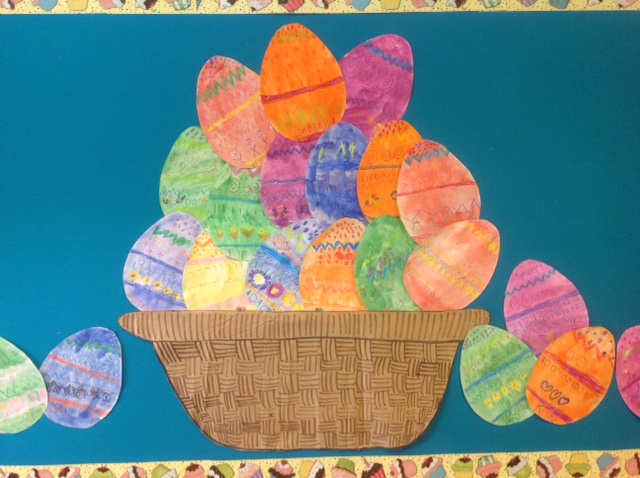
We also squeezed in one more post-Easter project, our beautiful patterned eggs done in wax crayon and watercolour resist.

IMG_2701

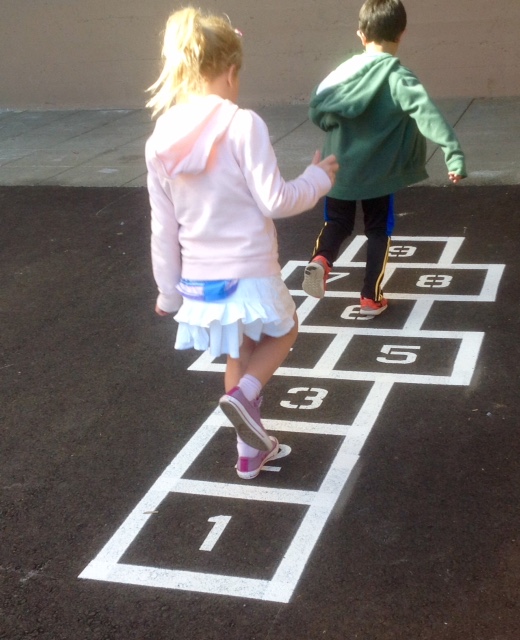
Many of you have probably noticed our beautiful recently paved playground with new painted lines for fun activities like Four Square and hop-scotch.  We’re really looking forward to more outdoor play as the weather continues to improve.

FullSizeRender-4

Upcoming Dates and Events

We start Badminton in PE on April 4.  Our classes will be taught Anna Rice, former Olympian and sister to our own Ridgeview teacher, Ms. Rice.  We’ve had the good fortune to be instructed by Anna in the past.  The children are going to receive excellent instruction and have lots of fun!  We will continue to have high expectations for student safety, listening and participation so that all students can learn.  Children must wear running shoes for PE days for the next two weeks.

PE for Division 15:  Tuesday and Thursday

PE for Division 16:  Monday and Friday

Wednesday, April 6, has been scheduled as the Vancouver Coastal Health finish-up day for those students who were absent, or did not have their screeners completed for Kindergarten vision, hearing and dental check.

We’re still collecting Tombola Goodie Bags for Mayfair, which takes place on Saturday, May 7 from 11 am-3 pm.  This is definitely the hottest ticket in town and we encourage all of our families to come out and support our school.  It’s really fun and the children will have a fantastic time.  Our organizers will be looking for donations for the booths soon, and we will you updated.

Happy Easter from the Self-Regulated Teacher

IMG_2674Happy Easter to all of our little Kindergarten Bunnies!  And the Big Bunnies, too.  There’s more than enough chocolate to go around.

Easter was a rather quiet affair this year in the Kindergarten, as the holiday was incorporated into our spring break this year (which we’re still on, until Tuesday).

However, far be it for us to let a holiday go by without some festivities!

We decorated our classroom as always….we know, very un-regulated of us, but it’s the holidays which are part of our tradition to celebrate all of the great festivals in our culture, even if it’s just a little bit.  And we can’t begin to tell you how much the children appreciate the beauty of our Easter trees and all the little decorations.

IMG_2670

In some ways we also consider this an opportunity to teach them that we can appreciate things just by looking, that we don’t have to touch everything.  They love to ask us questions about where we got our pretty objects, how long we’ve had them for, and we are able to teach them the importance of looking after one’s belongings and how to take care of them.  More life lessons from the Kindergarten….


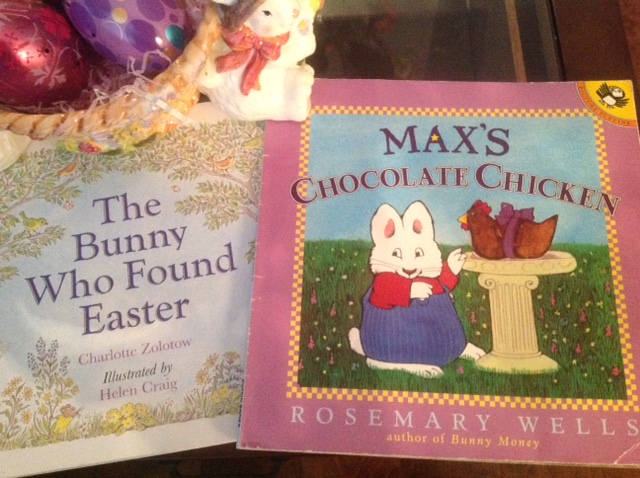
IMG_2693We read some very beautiful storybooks about Easter.

  • Max’s Chocolate Chicken (Rosemary Wells)
  • Max Counts His Chickens (Rosemary Wells)
    • The Bunny Who Found Easter (Charlotte Zolotow and Helen Craig)

IMG_0705


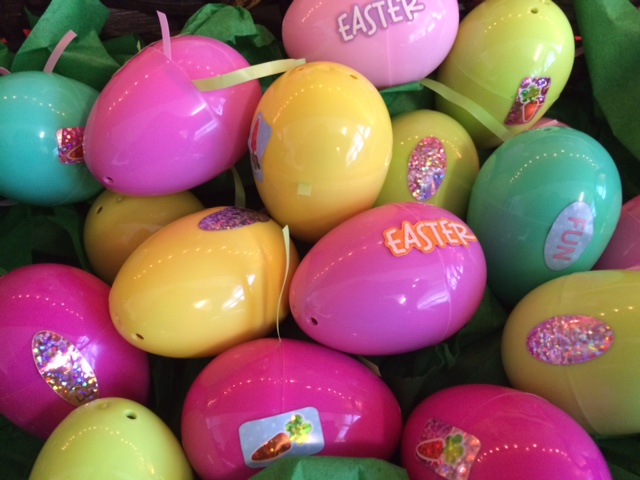
We didn’t have a traditional egg hunt, but we filled plastic eggs with jelly beans, Easter grass and some cut out letters to spell a special greeting….


Wishing you and your Bunnies a very Happy Easter!

FullSizeRender-3

The Self-Regulated Teacher’s Top 5 Most Read Posts for Term Two, January-March 2016

IMG_0728We’ve just finished the first week of our spring break, and have taken some time to get caught up on household duties, skiing, concerts, shopping, and future blog post ideas and scheduling.

But it also reminded us it’s the end of Term Two for our classes, and as usual we like to wrap it up with a summary and links to our top 5 most read posts in case you missed them.

IMG_1854Our Kindergarten Classroom Routines

Although teachers typically establish classroom routines in September, we’ve learned over the years that teaching routines is not something that can be done once and never referred to again.  Routines of any kind, for our students and ourselves as adults, need to be practiced and reinforced over and over to become a good habit and part of the natural way we do things.  So it is every autumn that we begin teaching routines to our new Kindergarten students on the first day of the Gradual Entry Program.  Routines provide calm and comfort for the children, particularly for transitions between activities.  The children have a sense of safety and security when they know what is expected not only of them, but their classmates as well.

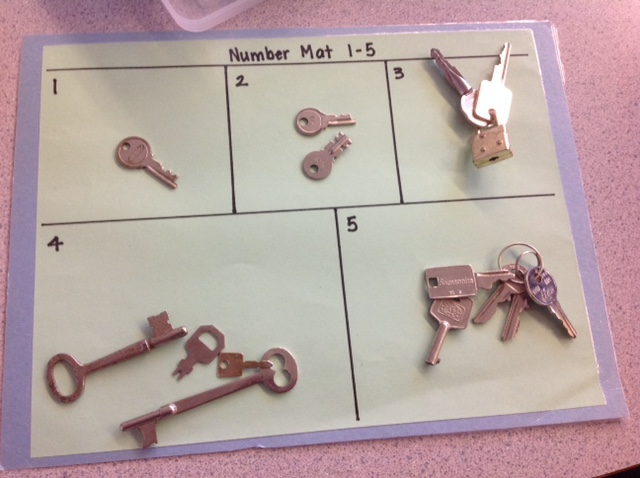
IMG_2478Math, the Kindergarten Way

We wrote this blog last April and we’re excited that it continues to remain informative for parents and teachers.  We’re still faithful to the basic principles of Math Their Way even after many years of teaching, a variety of new programs and new directions.  Math Their Way is just right for young children:  it is a manipulative based math program that focuses on developing a deep understanding of math concepts at the concrete (manipulative) level before the children start to make the connections between the concrete and abstract.  Every math unit we plan, from Patterning, to Sorting and Classifying, Number and Geometry and Measurement, begins with the manipulatives and planned time for the children to explore over a number of days before we begin direct instruction.

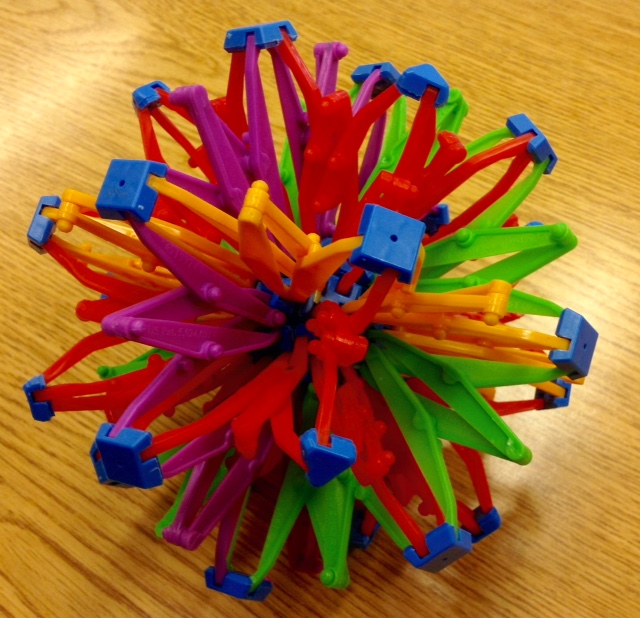
BreathingBallSelf-Regulation Tool:  The Breathing Ball

This little blog on the Breathing Ball (aka the Hoberman Sphere) has been visited often since we originally posted it in February 2015 .  We continue to use the Breathing Ball daily, either after the morning or lunch recess, to provide an important visual for our students for the deep breathing practise that we take so seriously in the Kindergarten.  Our dear SEA who retired last year always said to the children, “your breath is your friend.”  When we are out and about, in a hallway line-up to enter the gym for an assembly, waiting for our turn to perform at the Christmas Concert or anticipating a special snack, we turn to our “friend” and breathe deeply and calmly to help us focus so that we are always relaxed and ready to receive whatever the day is about to bring to us.

IMG_2474Understanding Phonological Awareness as Part of a Balanced Approach to Reading Instruction

A significant part of our Kindergarten program is to build upon the children’s phonological awareness, which has been developing since they were young.  In our school district we assess our students’ early literacy skills at the end of January, such as alphabet names and sounds, initial and final sounds of words and segmenting and blending skills, with a follow-up assessment in late spring.  For us, planning a balanced approach to reading instruction includes developing phonemic awareness and phonics instruction, along with the songs, rhymes and poems, read-aloud stories, environmental print, shared reading and independent reading opportunities that are a part of a rich, oral language experience.

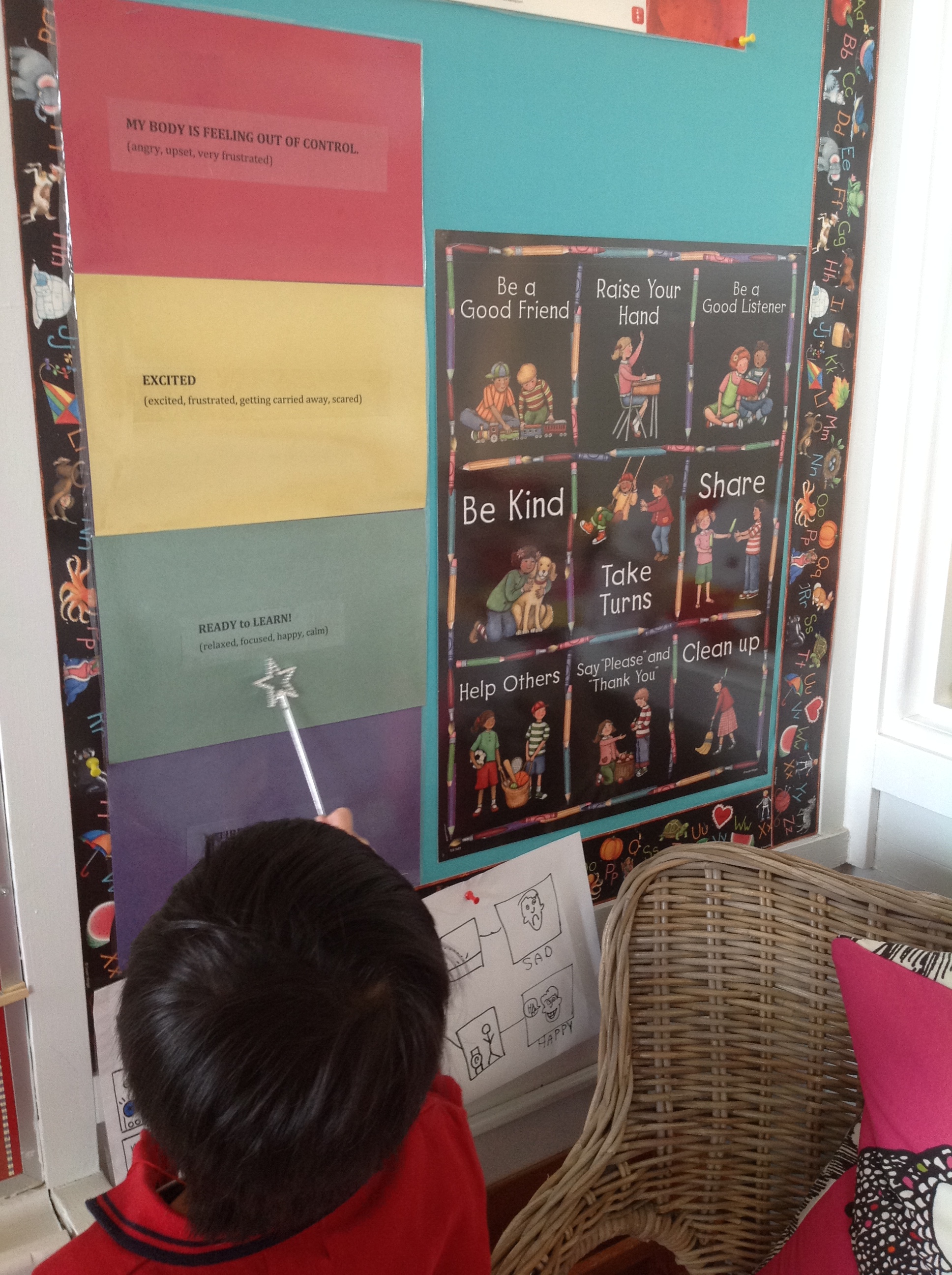
IMG_2584Setting Up the Self-Regulated Classroom

This year we made some significant changes to the physical arrangement of our classrooms based upon suggestions from Stuart Shankar (@StuartShankar) in his book Calm, Alert and learning:  Classroom Strategies for Self-Regulation.  From increasing our use of natural light, soft wall colours, uniform organisation of materials and noise reduction strategies, we are better able to support our students’ self regulation through the creation of a calm and peaceful learning space.


Waiting for Spring

FullSizeRender-1Well, we’ve certainly given our boots and raincoats a workout this week.  The weather has been it’s usual Vancouver self – rainy, moody and tempestuous.  The playground has been soaked with rain and we’ve brought more than our share of woodchips into the hallways and cloakroom areas.  We’ve been creative in using our outdoor undercover play space for running games, eating cupcakes and chalk play when the rain is pelting down just a little too hard.

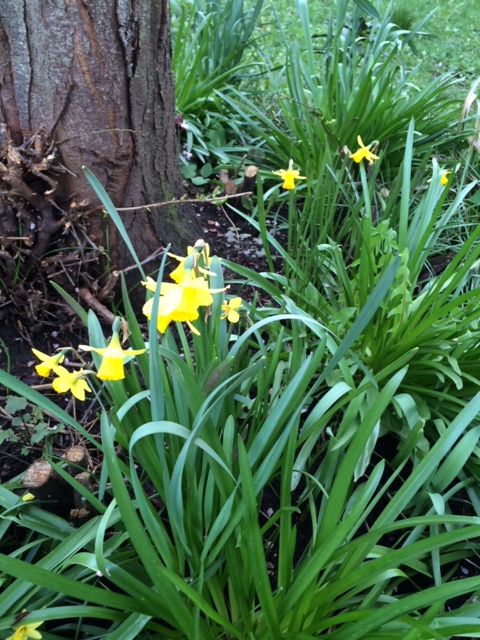
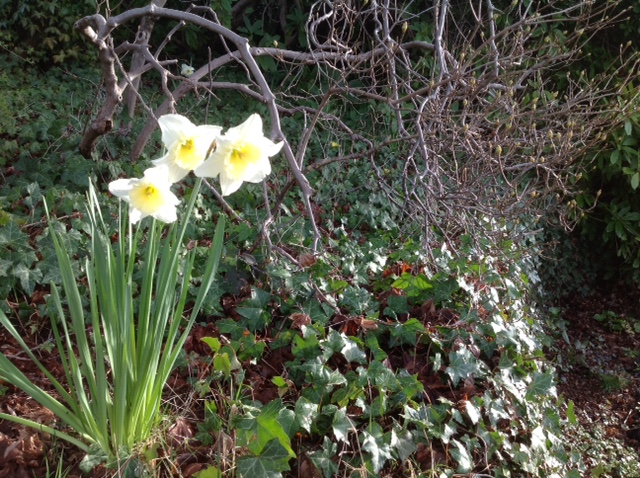
IMG_2684But we know Spring is just around the corner.  The air is cold, but softer than the icy winter wind. The children want to take off their jackets which is a sure sign.  We’ve tried to take advantage of every burst of bright sunshine glowing behind the clouds to get outside and play.  And we’ve got daffodils blooming in the school gardens so the gardeners among us are getting excited about the upcoming planting and growing season.

IMG_0692Another sign of Spring is the celebration of Nowruz, the Persian New Year.  And so this week we celebrated Nowruz, in our classrooms.  Thank you to all our parents for their wonderful planning and organization to make this a special day for our Kindergarten children and for teaching us about this important cultural event.  Nowruz traditionally occurs around the first day of Spring.

In addition to some fun crafts, colouring and snacks, our parents set up a beautifully decorated display, the “Haft Sin” table.  In the Farsi language, “Haft Sin” means the Seven S’s, as there are seven items on the table that begin with the letter S.  Each of the items is a symbol of an important aspect in life:

IMG_2666

  • Sabzen (wheat sprouts) for Rebirth
  • Sib (apple) for Beauty and Health
  • Sir (garlic) for Medicine
  • Serkeh (vinegar) for Age and Patience
  • Sumac for the Colour of the Sunrise
  • Senjed (silver berry) for Love
  • Samanu (sweet pudding) for Affluence from “Nowruz (SimplyExplained)”

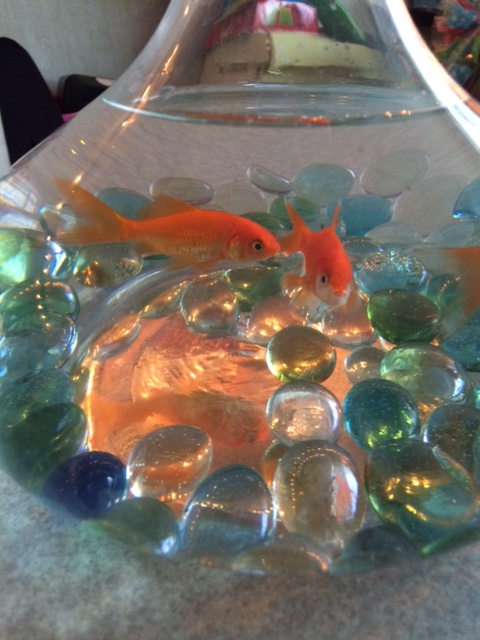
There were many other lovely items on the table including a hyacinth, fruit basket, sweets, mirrors, coins, decorated eggs, candles and a glass bowl with fish.  One of our parents explained that the fish represented movement, or moving forward into the new year, leaving the old year behind.

This Week in Our Room:  March 7-11, 2016

The children were able to take out a library book this week for the two-week spring break holiday.  Here are some important and helpful reminders from Mrs. Kennedy, our Teacher-Librarian:

  • Leave your library book at home while travelling over spring break.  We’ve had some difficulty in the past years when families have taken the children’s library books on planes, trains and automobiles.  The books were left in holiday homes and hotels and (almost) impossible to get them back.
  • Your library book has been borrowed by your child.  Please safeguard your library books from younger brothers and sisters.
  • Please also be mindful of pet proximity to your library book as it will be home for a longer time period than usual

Our classes were not able to complete the Vision, Hearing and Dental screeners with all students, so Vancouver Coastal Health nurses will return after Spring Break to finish checking all the children.

We’re coming to the end of our Penguin Inquiry student, so we made these little cuties!

IMG_5144

We wish everyone a safe and happy spring break, and we’ll see everyone back at school on Tuesday, March 29.


Art Lesson: Snowy Owlets

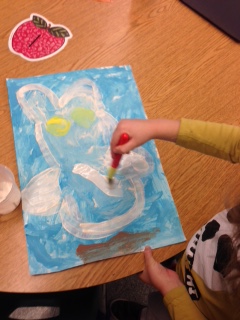
FullSizeRender-13Christy and I were recently asked if we teach art in small groups or as a full class lesson.  The answer?  Both!  Like most things, it really depends upon the task and if we think the children (and us) are able to manage the art tools, techniques and processes we want to use in a full class setting, which is definitely our preference at this point in the school year.  We’re both well aware that in a few short months our children will be in Grade One and we need to provide them with art experiences and opportunities to be fully independent in a classroom of their peers.  However, if we are at all doubtful, or as circumstances dictate (like this week), we will then opt for small group work; this takes longer, but gives us more control so we can provide the correct level of support for those children who require more.

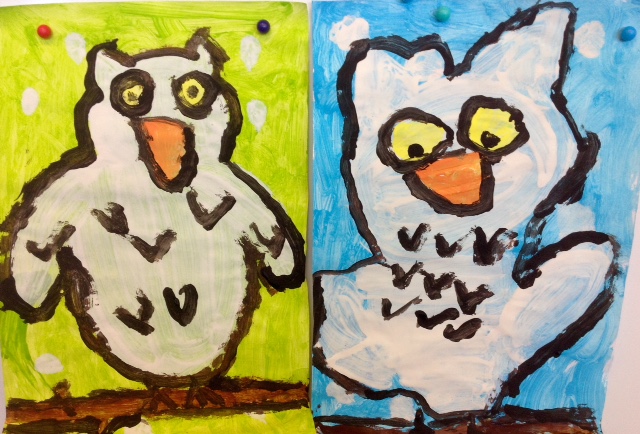
One of our favourite painting projects is the Snowy Owls from Patty Palmer’s fantastic website Deep Space Sparkle.  (You can click on the link for her lesson description with lots of examples).  We’ve taught this art piece several times and always enjoy it as a full-on painting experience with the Kindergarten.  However, one of the children made the observation that these were baby owls, not adult ones, so we renamed our project to Snowy Owlets.

We like to use soft, bright colours for the painted background.  We had previously set the tables with paper and paint while the children waited at the carpet.  We always go over our expectations during a meeting time at the carpet before the children move to their seats, as there can be too many distractions on the table for them to listen fully to the instructions.  The children were assigned to tables with the understanding that “You get what you get, and you don’t get upset” in terms of background colour.  We use that expression a lot and the children always accept it with good humour.

We have a real mish mash of paintbrushes this year.  Lots of long handled paintbrushes and not enough short handled ones for small hands.  Quite a few children were willing to work with a full size brush, even though it can be unwieldy because of the length of the handle. These children felt they could manage because of their previous painting experiences and they did a great job!  The children’s self-regulation while we handed out brushes and individually negotiated sizes was remarkable as this task takes some time.

Time now for a little Bach and Vivaldi and let the painting begin!

IMG_2582

After all the backgrounds are painted and dry, we flatten them out by placing the stack of papers under the puzzles for a few days.  A mostly flat surface, with no curling edges, makes painting the owlets much simpler.

Next, the children painted snow and the owlet bodies in white.  For the first time, I painted mine in small groups this year because we had no block long enough for me to paint with the whole class this week, so I squeezed in small groups during the morning Activity Time.  Christy painted her owl bodies with the whole class and you can see how beautifully all the children’s work turned out.

IMG_5129

The last step is the fine details.  Again, in groups of four, the children managed one palette of yellow, orange, brown and black paint between them.  They all painted the eyes yellow; the beaks orange; the branch brown; and finally did the outlining in black, in that order.  The children were troubled about dipping their brush into the next colour without cleaning it first, but they soon saw that the darkest colour absorbed the lighter ones they had used previously.

We just love our little owlets, real and painted!  Aren’t these super cute?!

IMG_5122

This Week In Our Room:  February 29-March 4, 2016

We’ve had lots of fun and excitement this week.

We had some very special visitors from West Vancouver Fire and Rescue come to see us on Wednesday.  Captain Marcia James and Assistant Chief Jeff Bush gave us a short talk on the role of firefighters in our community and some of the tools they use for fighting fires.  One of the most important things we learned is that firefighters do much, much more than just put out fires.  They are helping people all the time, from those who are very sick at home to those who might be injured in some way.  That is why we call them West Vancouver Fire and Rescue.

We had a special treat when the fire truck pulled onto the playground and the children were all able to climb up into the truck and sit on one of the seats.  Some of the children wore the firefighters’ headsets and very cute they were indeed!

FullSizeRender

We saw the yellow hoses, played with one of the water valves, carried the jaws of life and tested out the weight of a firefighter’s helmet.  And we had quite a long discussion about the blocks used to stop the fire truck from moving, or rolling backwards, while the firefighters were working.

We will be writing more about our West Van Fire and Rescue visit in an upcoming blog post.

It might seem like we are on a bit of a bird theme (we’re not, but this just occurred to us) as we decided to get started on our March self-portraits using a penguin background.  How about these cuties?

On Friday we also welcomed the West Vancouver Secondary School Concert Band and Concert Choir.  Many members of these musical groups are Ridgeview alumni so it’s always wonderful for the school staff to see how beautifully our former students have grown up and continuing to pursue their musical passions.

Upcoming Events and Reminders

Ideally, we would have all Library Books returned before Spring Break, so please try to return your book on your appointed Library Day.  Division 15 Library Day is Monday and Division 16 Library Day is Tuesday.

We will be sending home the children’s report cards on Friday, March 11.  We are unable to send them home earlier than Friday.

Mayfair is Saturday, May 7, this year and it is always very fun!  We’re asking everyone for a donation of two goodie bags for the Tombola Challenge, so please return your two bags when you can.  We have examples in our classroom if you wanted to see some.  Thanks to those families who’ve already brought their bags to school.

School will dismiss early on Friday, March 11 at 2 pm.  This marks the beginning of Spring

Break, which includes Good Friday and Easter Monday this year.  School re-opens for the Spring Term on Tuesday, March 29.